Reverberation, Antenna, Automotive, and Military-Grade Test Chambers
A standard semi-anechoic chamber covers the majority of general radiated emissions and immunity compliance testing, but several specific test applications need a fundamentally different chamber design — a different internal geometry, a different measurement principle, or dedicated integration with drivetrain test equipment that a standard SAC isn't built to accommodate. This range covers those specialised chamber types.
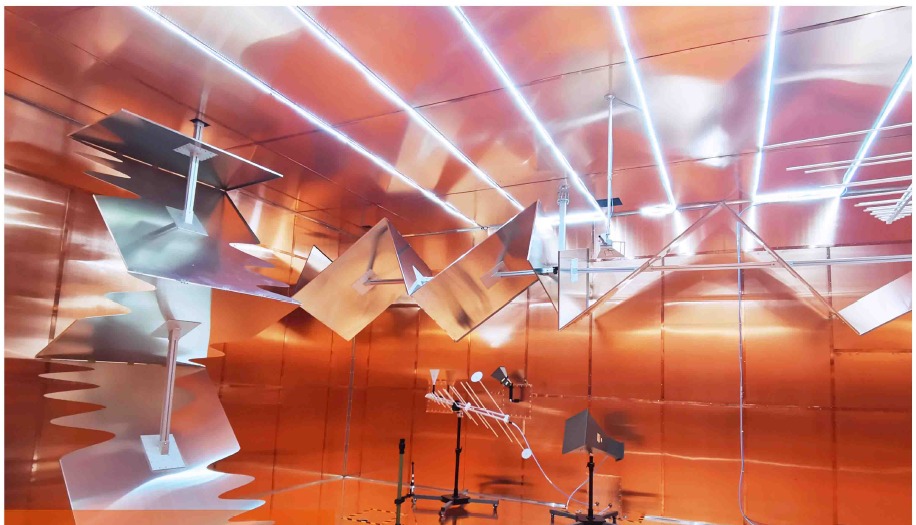
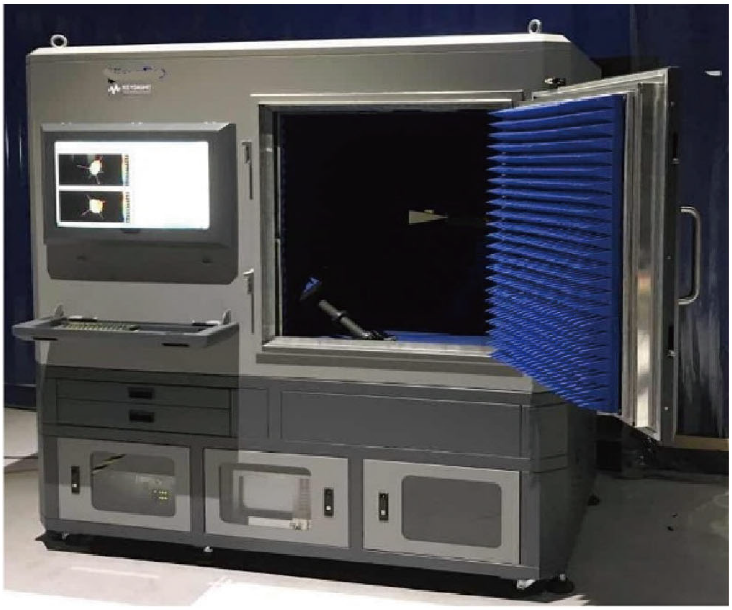
Reverberation chambers use a statistically-based field testing approach (rather than the deterministic free-space field a semi-anechoic chamber generates) to standards like IEC 61000-4-21 and MIL-STD-461, well suited to applications needing a statistically uniform field distribution rather than a single well-defined incident wave. Antenna and microwave chambers support far-field and near-field antenna characterisation specifically — a different measurement task from testing a general device under test, requiring chamber geometry optimised for antenna pattern and gain measurement rather than general EMC compliance.
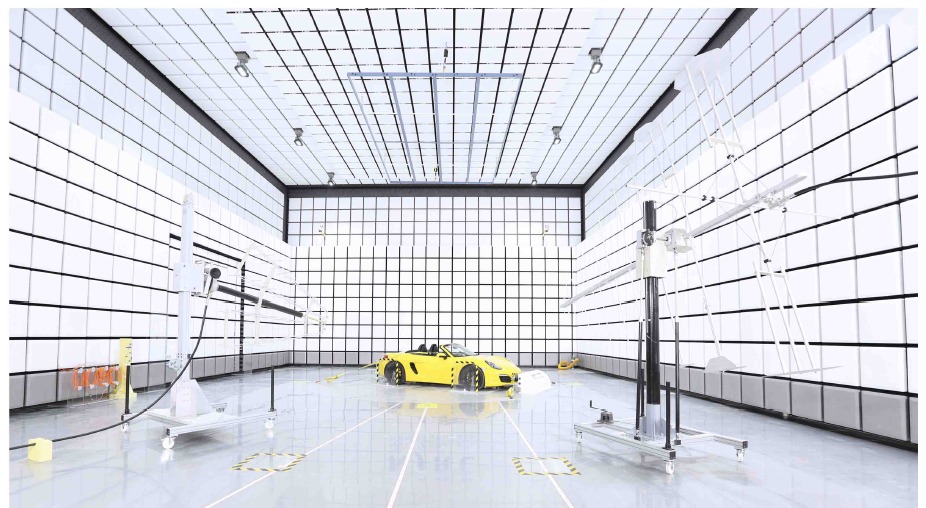
EV and drivetrain dynamometer-integrated chambers combine EMC test capability with the dynamometer needed to run a motor or drivetrain under load during testing, built to CISPR25 and GB/T 18655 for automotive-sector EMC compliance under realistic operating conditions. Dedicated military (MIL-STD-461) and automotive component (CISPR25) test facilities round out the range, purpose-built and pre-configured for their specific sector's compliance requirements rather than a general-purpose chamber adapted after the fact.
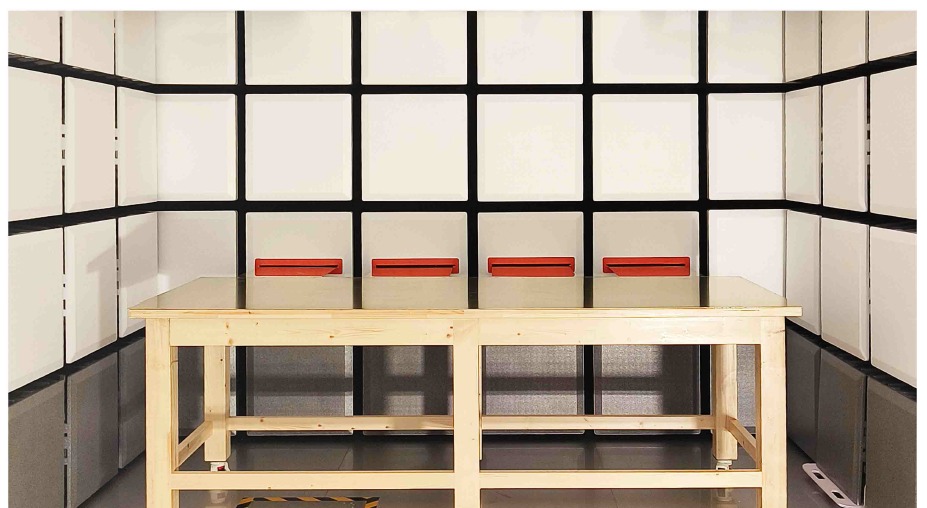
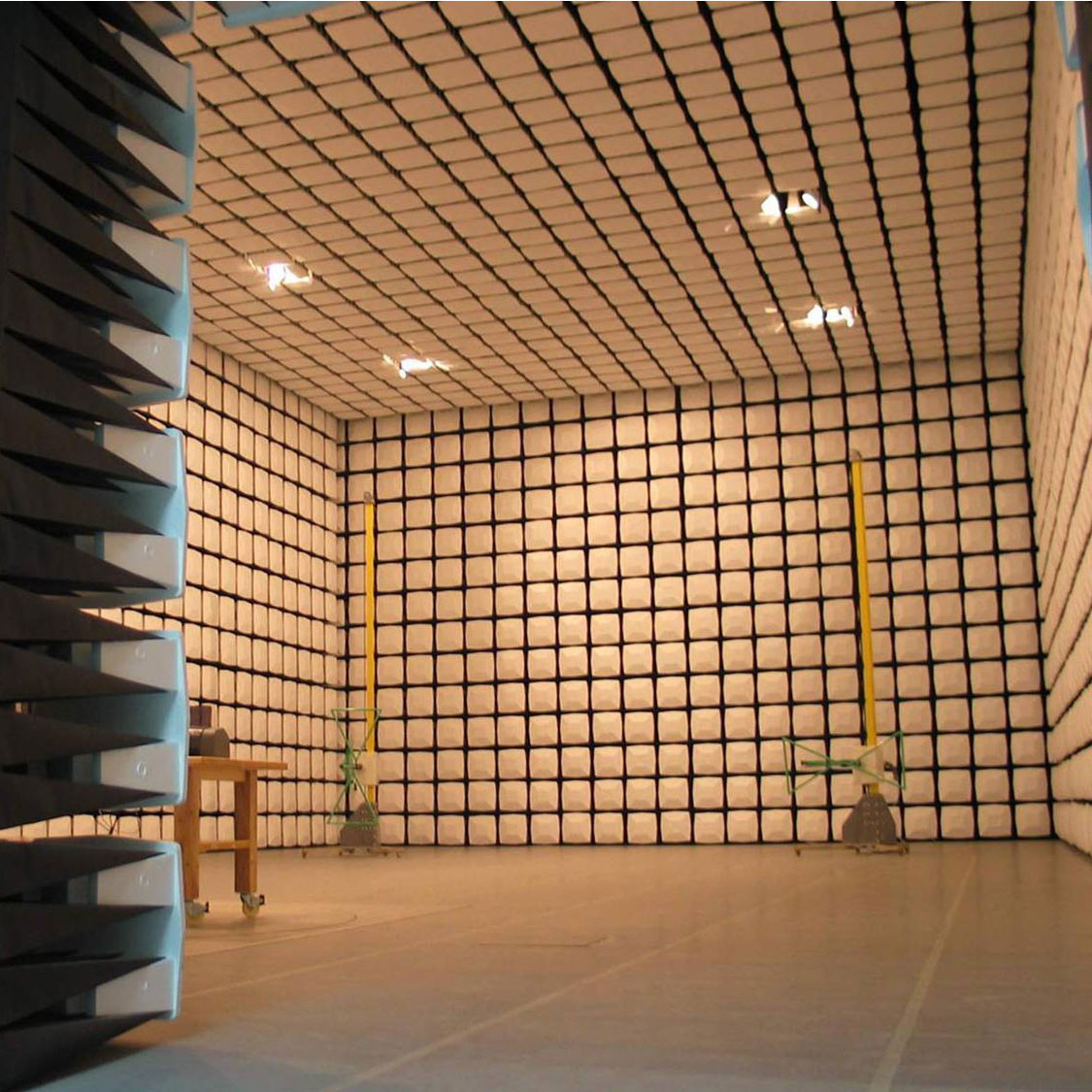
A semi-anechoic chamber uses absorber-lined walls to create a controlled, deterministic free-space field for measurement against a single defined test angle at a time. A reverberation chamber instead uses a highly reflective (not absorptive) enclosure with mode-stirring to create a statistically uniform field, testing against IEC 61000-4-21 and MIL-STD-461 with a fundamentally different measurement approach.
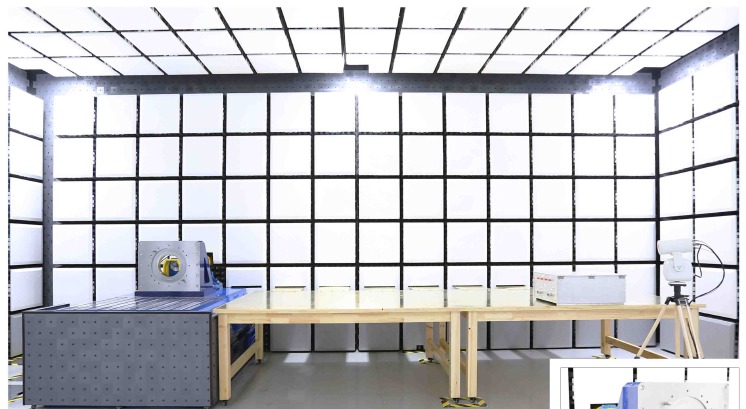
Electric drivetrains emit differently, and often more, when running under load than when idle. A dynamometer loads the motor inside the chamber, so CISPR 25 and GB/T 18655 measurements reflect real operating conditions.
Where the specific compliance standard (MIL-STD-461 for military, CISPR25 for automotive) has particular chamber configuration, size, or measurement setup requirements that a general-purpose semi-anechoic chamber isn't pre-configured for, a dedicated sector-specific facility avoids the need to adapt or reconfigure a general chamber for each test.
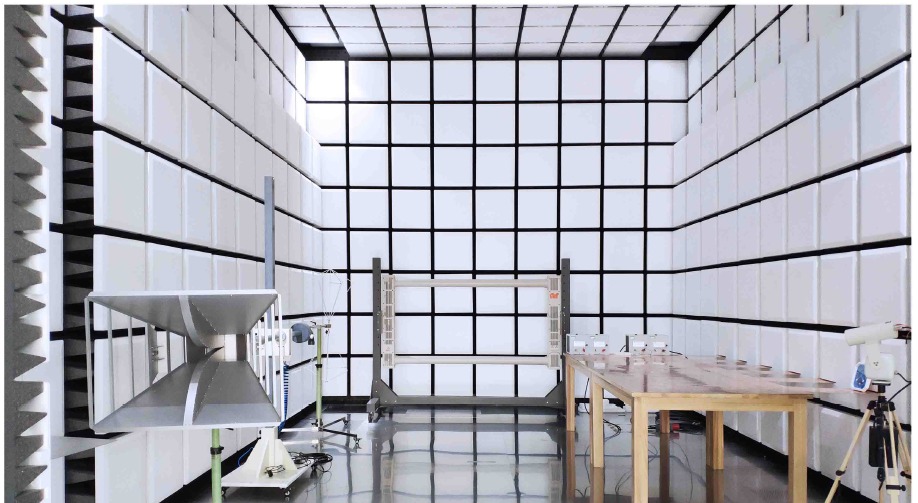
These chambers do very different jobs. Start with what you need to test, then read the description to check it fits. For general commercial emissions and immunity compliance, a semi-anechoic chamber is usually the right starting point.
| Go to | You need to test |
|---|---|
| TEM Cell | Immunity or emissions of small products and modules on the bench; probe calibration |
| Reverberation Chamber | High-field immunity for avionics and defence (DO-160, MIL-STD-461 RS103, IEC 61000-4-21); TRP |
| Antenna Measurement Chambers | Antenna patterns, gain and radar cross section |
| OTA Test Chamber | Over-the-air performance of 5G and wireless devices |
| 3 m Full Anechoic Chamber | Free-space tests with no ground plane, including below 30 MHz |
| CISPR 25 Automotive Component Chamber | Emissions from vehicle electronics to CISPR 25 |
| EV and Drivetrain Chamber | EV motors and drivetrains running under load |
| MIL-STD-461 Chamber | Military equipment to MIL-STD-461 |
| Compact Diagnostic Chamber | In-house EMC diagnostics during development |
| LISUN 3 m and 5 m Anechoic Chambers | A prefabricated semi- or full-anechoic chamber at 3 m or 5 m |
Chambers that create a test field in a different way from an anechoic room.
TEM-420-200What it is
A closed, shielded section of transmission line. A flat inner conductor (the septum) produces a uniform, calculable field between itself and the floor, so small samples can be tested without an anechoic chamber. Benchtop size, about 10 kg.
Use it for
| Frequency | DC to 420 MHz (550 MHz option) |
|---|---|
| Field strength | 200 V/m calibration field |
| Largest sample | 120 × 120 × 120 mm |
| Max. input power | 1000 W |
| Standards | IEC 61000-4-20, ISO 11452-3, IEEE 1309 |
RC80 / RC200 / RC-LUF400 / RC-LUF1000What it is
A shielded room with reflective metal walls and a rotating mode stirrer. Instead of one plane wave from one direction, it creates a statistically uniform field that hits the EUT from every direction, and reaches high field strengths with less amplifier power.
Use it for
| Lowest usable frequency | 80 MHz, 200 MHz, 400 MHz or 1 GHz |
|---|---|
| Test area | RC80: 7.0 × 7.0 × 4.5 m; RC200: 2.5 × 1.8 × 2.3 m |
| Choosing a size | The lower your lowest test frequency, the bigger the room |
| Standards | IEC 61000-4-21, MIL-STD-461, RTCA DO-160, EUROCAE ED-14 |
For measuring antennas and wireless devices rather than EMC compliance.
ANT-NF / ANT-FF / ANT-CR / ANT-CEMSWhat it is
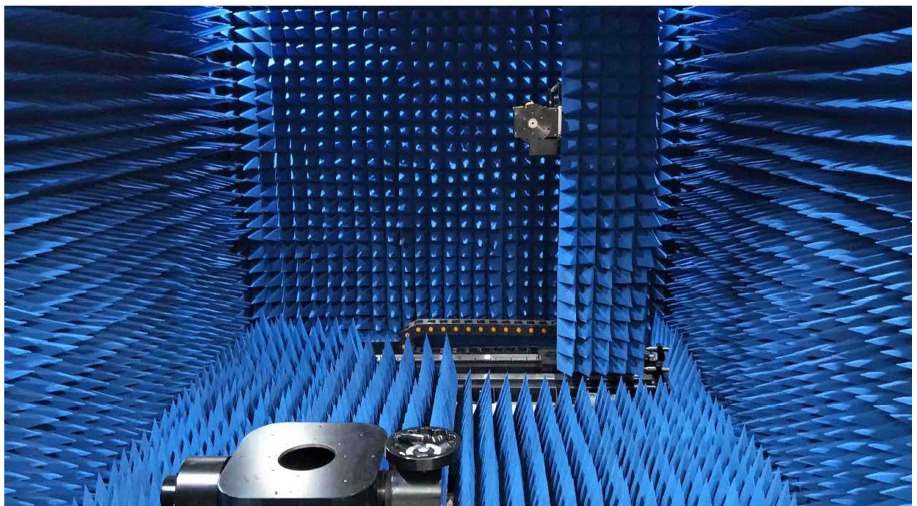
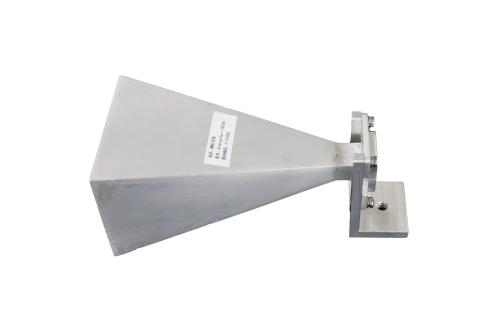
Microwave anechoic chambers built around one antenna measurement method. Near-field chambers scan amplitude and phase close to the antenna and calculate the far field; far-field chambers measure the pattern directly at distance; compact-range chambers use a parabolic reflector to create a plane wave in a smaller room.
Use it for
| Configurations | Near field (planar, cylindrical, spherical), far field, compact range/RCS, complex EM |
|---|---|
| Absorber | Dense microwave absorber for mmWave |
| Size and frequency | Custom quiet zone and frequency range |
| Standards | IEEE 149, IEEE 1720 |
ANT-OTAWhat it is
An antenna chamber set up for over-the-air testing of complete wireless devices rather than bare antennas, measuring how a finished product performs through its own antennas.
Use it for
| Quiet zone | Custom |
|---|---|
| Absorber | Microwave absorber |
| Shielding | Pan-type galvanised steel |
| Standards | IEEE 149, IEEE 1720 |
3m-FARWhat it is
Absorber on all six surfaces, including the floor, so there is no ground-plane reflection and the room behaves like free space. Not used for CISPR 16 ground-plane emission tests, which need a semi-anechoic chamber.
Use it for
| Measurement distance | 3 m |
|---|---|
| Absorber | Hybrid or microwave, on all six surfaces |
| Frequency range | Custom to the application |
| Standards | EN 50147-1 shielding effectiveness |
Laid out for CISPR 25 components, or with a dynamometer for drivetrains under load.
CISPR25-ACWhat it is
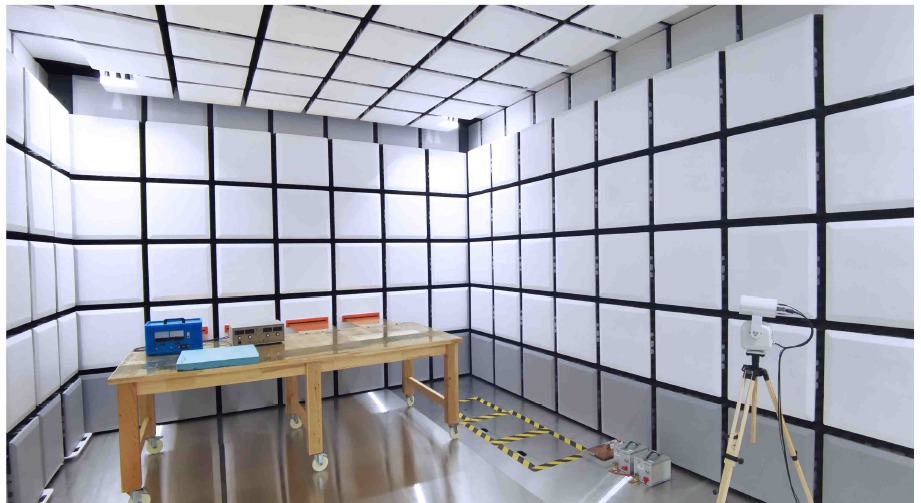
An absorber-lined shielded room with a metallic ground-plane bench that represents the vehicle body. It is laid out for the CISPR 25 component set-up: antenna 1 m from the harness, artificial networks and standard component placement.
Use it for
| Antenna distance | 1 m from the harness |
|---|---|
| Ground plane | Metallic bench simulating the vehicle |
| Size | Custom for harness and subsystem assemblies |
| Standards | CISPR 25, GB/T 18655 |
EVC-DA / EVC-DDWhat it is
An EMC chamber with a dynamometer and battery simulator built in, so EV motors, controllers and drivetrains are measured while running under load, not sitting idle. Choose the dual-axis (DA) or direct-drive (DD) dynamometer.
Use it for
| Dynamometer | 250 / 300 / 350 kW; to 15,000 rpm |
|---|---|
| Torque | 570 / 1000 / 4000 N·m |
| Battery simulator | Up to 1500 V, ±1200 A, regenerative |
| Standards | CISPR 25, GB/T 18655 |
Built around the MIL-STD-461 bench set-up.
MIL-STD-ACWhat it is
A shielded, absorber-lined room laid out for MIL-STD-461 test methods: bonded ground-plane bench, antenna 1 m from the bench edge, LISNs and bulk current injection.
Use it for
| Geometry | 1 m measurement distance, ground plane, LISN, BCI |
|---|---|
| Shielding | High-performance pan-type; custom attenuation |
| Size | Custom to EUT and test methods |
| Standards | MIL-STD-461 |
Pre-compliance diagnostics, and LISUN prefabricated 3 m and 5 m chambers.
SAC-CDCWhat it is
A small, absorber-lined semi-anechoic chamber for finding and fixing EMC problems in-house during development, before booking a compliance test at an accredited lab.
Use it for
| Type | Compact pre-compliance semi-anechoic chamber |
|---|---|
| Size and frequency | Custom on enquiry |
| Standards | Pre-compliance diagnostics |
AC-3M / AC-3MF / AC-5M / AC-5MFWhat it is
Prefabricated LISUN chambers in semi-anechoic form (AC-3M, AC-5M, bare floor for ground-plane emission tests) or full-anechoic form (AC-3MF, AC-5MF, all six sides covered for free-space tests).
Use it for
| Frequency | 9 kHz / 30 MHz to 18 GHz |
|---|---|
| Quiet zone | Ø2.0 m (3 m models); Ø3.0 m (5 m models) |
| NSA | ±3.5 dB (30 MHz to 1 GHz) |
| External size | 9.5 × 6.5 × 6.5 m (3 m); 12.5 × 8.5 × 7.5 m (5 m) |
| Standards | CISPR 16-1-4, IEC 61000-4-3, ANSI C63.4, MIL-STD-461G |
Chambers are built to order. Tell us your standards, EUT size and frequency range and we will propose a chamber type and layout. Read more: semi-anechoic, full anechoic or reverberation chamber? and reverberation chambers for DO-160 and MIL-STD-461.


Where a standard Semi-Anechoic Chamber doesn't match the standard you're testing to, one of these purpose-built alternatives usually does. Reverberation chambers suit DO-160 Section 20 and MIL-STD-461 RS103 where the standard permits a mode-stirred field instead of absorber-lined testing — often more cost-effective than an equivalent SAC. EV and drivetrain chambers integrate a dynamometer so motors and drivetrains can be tested under load to CISPR 25 and GB/T 18655, the CISPR25-AC chamber is laid out for CISPR 25 and ISO 11452-2 component testing at 1 m, and military-grade chambers are built to MIL-STD-461's specific shielding and absorber requirements rather than commercial specifications.
Choosing between this range and a standard SAC comes down to which standard you're testing to, and whether it explicitly permits or requires one of these specific chamber types.