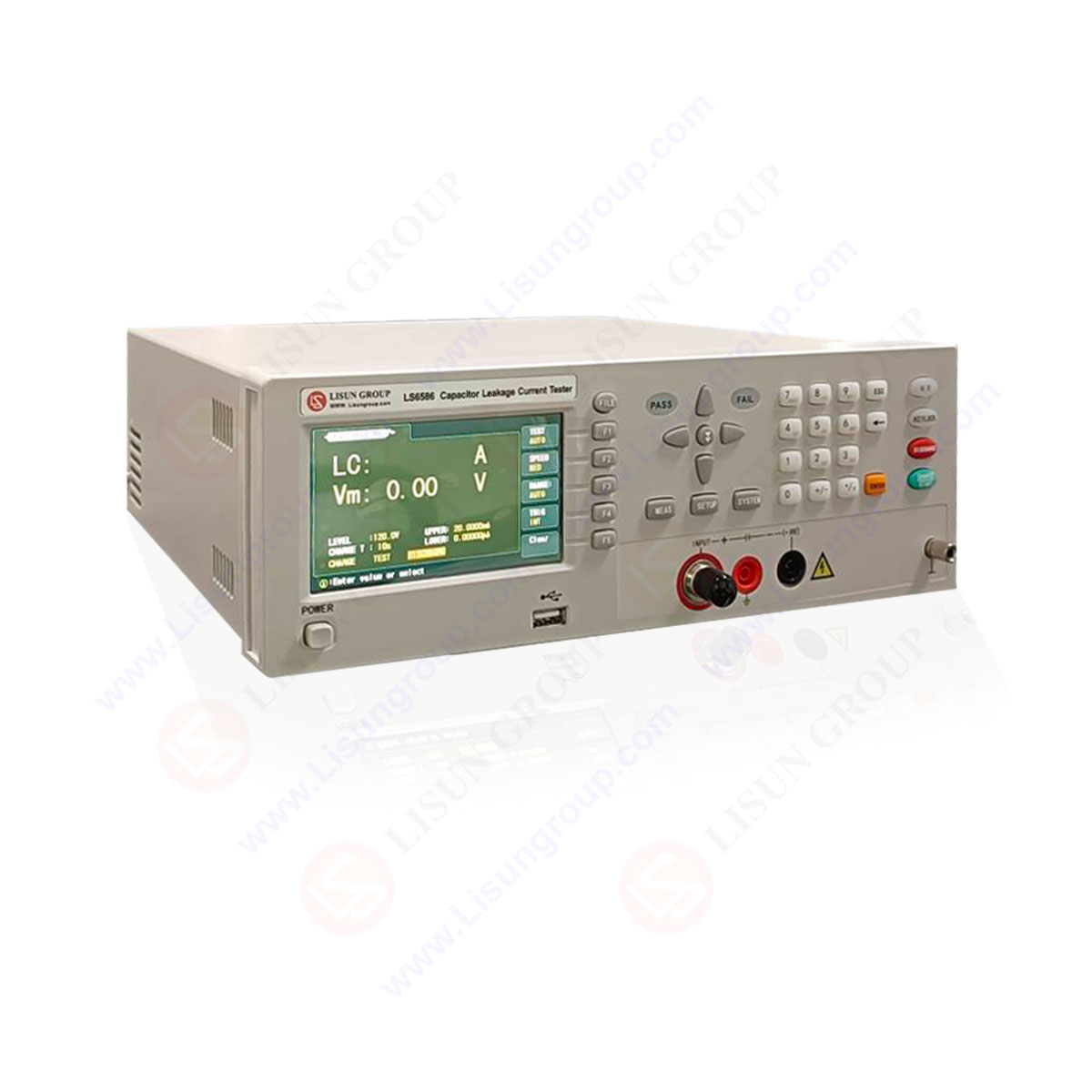
Capacitor Leakage Current Tester
Leakage current measurement for electrolytic and film capacitors.
Leakage current — the small but real current that flows through a capacitor's dielectric even under steady-state DC voltage — is a key indicator of capacitor quality and can predict early failure well before other parameters show a problem. LISUN's LS6586 Series measures leakage current specifically for electrolytic and film capacitors, built for production-line testing where catching elevated leakage before a capacitor ships matters.
Electrolytic and film capacitors both have characteristic leakage behaviour, but the underlying causes and acceptable thresholds differ between the two dielectric types — electrolytic capacitors typically show higher baseline leakage due to their oxide-layer dielectric construction, while film capacitors are expected to show very low leakage given their different dielectric material. Testing across both types with appropriate methodology for each ensures the leakage measurement is meaningful for the specific capacitor technology being tested, rather than applying a one-size-fits-all threshold that doesn't account for these underlying differences.
On a production line, leakage current testing catches manufacturing defects — a compromised dielectric, contamination, or process variation — that might not show up in a basic capacitance measurement but that predicts elevated failure risk or reduced service life once the capacitor is in a finished product.
Frequently Asked Questions
Why does leakage current matter as a quality indicator beyond capacitance value?
A capacitor can measure the correct capacitance while having a compromised dielectric that allows excessive leakage current — a defect that capacitance measurement alone won't reveal. Elevated leakage indicates dielectric quality issues that can predict reduced service life or elevated failure risk once the capacitor is in service.
Why do electrolytic and film capacitors need different leakage testing considerations?
Electrolytic capacitors use an oxide-layer dielectric that inherently exhibits higher baseline leakage than a film capacitor's dielectric material, so what counts as acceptable leakage differs meaningfully between the two technologies — testing needs to account for these different expected baselines rather than applying one universal threshold.
Is leakage current testing typically done at 100% on a production line, or as a sample check?
This depends on the specific application's quality requirements and volume — some production lines test every unit, particularly for applications where capacitor reliability is critical, while others use sample-based testing for lower-criticality applications. The tester's throughput and the specific quality programme determine which approach is used.