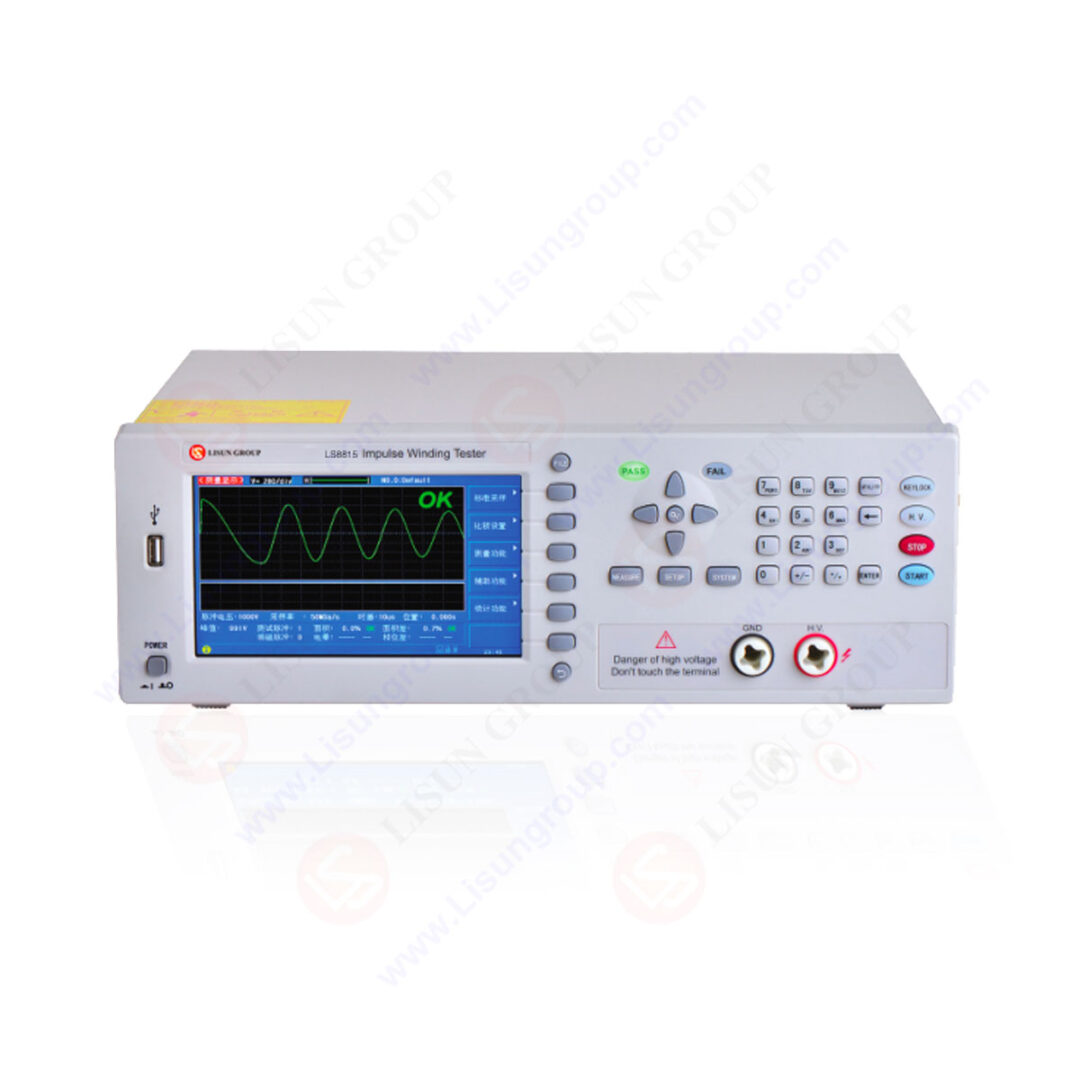
Impulse Winding Tester
Inter-turn insulation fault detection for motor and coil windings.
Inter-turn insulation faults in a motor or coil winding — a short between adjacent turns caused by damaged wire insulation — are notoriously difficult to catch with a simple resistance measurement, because a partial or intermittent short can still pass a basic continuity or resistance check while remaining a real defect that leads to early failure. LISUN's LS8815 Series is built specifically to catch this failure mode using surge/impulse comparison testing.
Impulse (surge) testing applies a high-voltage impulse to the winding and compares the resulting waveform response against a reference or against other windings in a multi-winding test — inter-turn insulation faults distort this waveform response in a detectable way that a simple resistance measurement misses entirely, because the fault manifests as a dynamic response difference under transient stress rather than a steady-state resistance change. This makes impulse testing a meaningfully more sensitive detection method for exactly the failure mode that matters most for motor and coil winding quality.
This test method is particularly valuable in motor manufacturing and coil winding QC, where inter-turn insulation faults that pass a basic resistance check can still lead to premature field failure — catching these faults before the winding leaves the production line avoids a much more costly failure and potential warranty claim once the finished product is in service.
Frequently Asked Questions
Why does a simple resistance test miss inter-turn insulation faults that impulse testing catches?
A partial or intermittent inter-turn short can still measure acceptable resistance under a steady-state test, because the fault's effect on overall winding resistance is small or inconsistent. Impulse testing instead applies a transient high-voltage stress and compares the resulting waveform shape, which is sensitive to insulation faults that don't show up as a simple resistance change.
How does surge/impulse comparison actually detect a fault?
The test applies a high-voltage impulse and captures the winding's transient voltage response, comparing it either against a known-good reference waveform or against other windings tested in the same batch — an inter-turn insulation fault distorts this response waveform in a way that's visible in the comparison, even when it wouldn't show up as an out-of-tolerance resistance reading.
Why does inter-turn insulation testing matter specifically for motor manufacturing?
Motor windings experience significant electrical and thermal stress in service, and an inter-turn insulation fault that passes production testing but exists as a latent weakness can progress to a full winding failure in the field — catching it during production testing, before the motor is built into a finished product, avoids a much more costly and disruptive field failure.