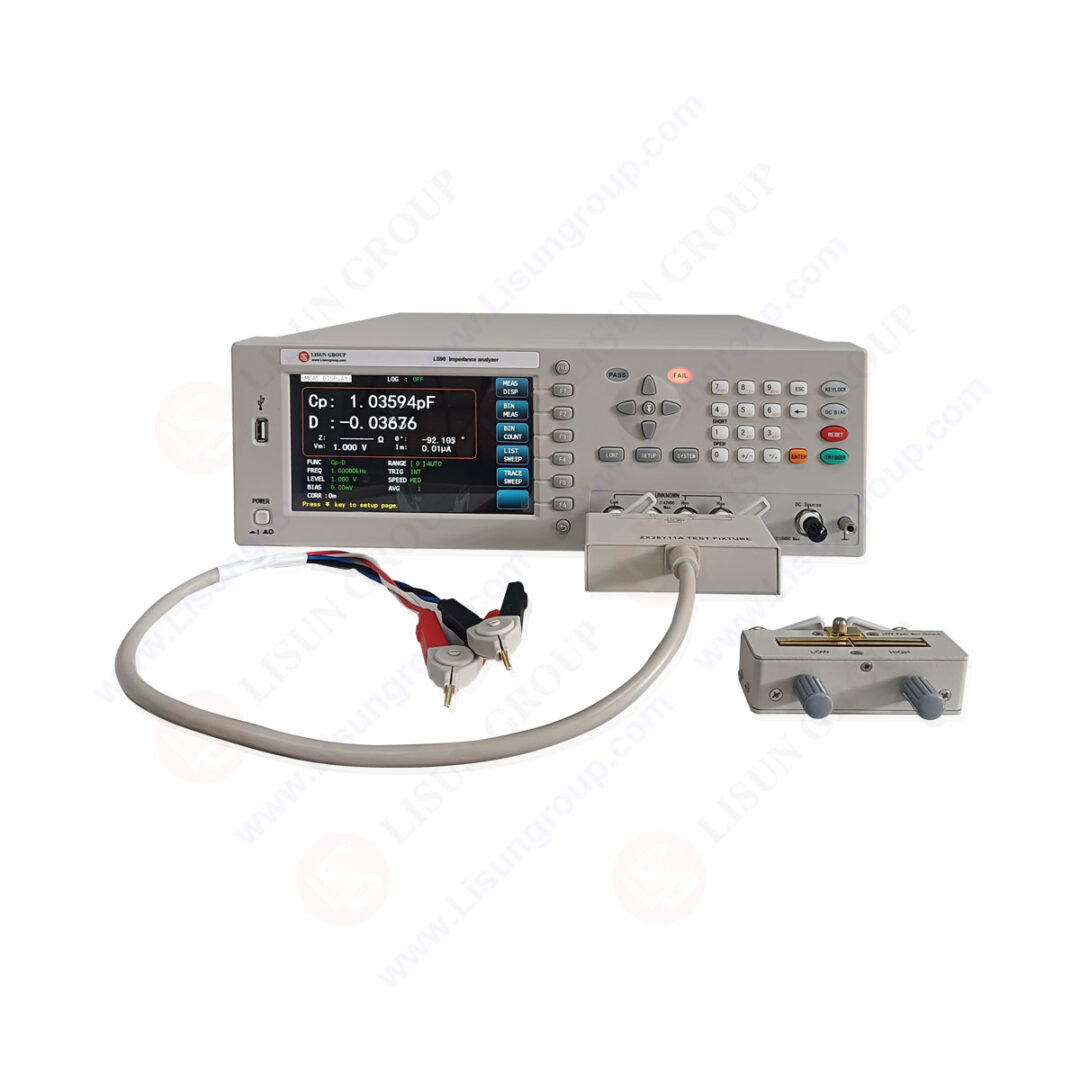
Impedance Analyzer
Precision impedance, inductance, capacitance, and resistance measurement for component R&D and production QC.
Component R&D and production QC both sometimes need more than a standard LCR meter provides — precision impedance characterisation across a wide frequency range, capturing how a component's impedance, inductance, capacitance, and resistance behaviour actually changes with test frequency rather than a single fixed-frequency reading. LISUN's LS90 Series addresses this broader characterisation need directly.
Measuring impedance, inductance, capacitance, and resistance across a wide test frequency range gives a much fuller picture of a component's electrical behaviour than a single-frequency measurement can provide — many real components exhibit meaningfully different characteristics at different frequencies, and a design or qualification process that only checks one frequency point can miss behaviour that matters at the component's actual operating frequency or across the frequency range it will experience in service.
This makes the LS90 well suited to both component R&D — where understanding a component's frequency-dependent behaviour is often central to the design or characterisation task — and production QC, where verifying a component's impedance characteristics match specification across the relevant frequency range provides more confidence than a single-point check.
Frequently Asked Questions
Why does measuring impedance across a range of frequencies matter more than a single-frequency reading?
Many components — particularly inductors, transformers, and other magnetic or reactive components — exhibit impedance characteristics that change meaningfully with frequency due to effects like core saturation, parasitic capacitance, or skin effect. A single-frequency measurement can miss behaviour that only becomes apparent when sweeping across a wider frequency range relevant to the component's actual application.
What's the difference between an impedance analyzer and a standard LCR meter?
A standard LCR meter typically measures at one or a limited set of fixed test frequencies, while an impedance analyzer like the LS90 is built to characterise impedance behaviour across a wide, often continuously variable frequency range — giving a more complete frequency-dependent picture rather than isolated data points.
Is the LS90 suited to production QC, or only R&D characterisation work?
Both — while wide-frequency-range characterisation is often central to R&D work understanding a new component's behaviour, the same capability supports production QC verification where confirming impedance characteristics across a relevant frequency range (rather than just one point) provides stronger assurance of component quality.