Regenerative Grid Simulators
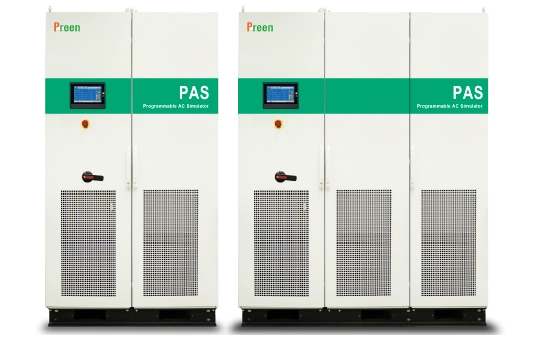
Regenerative AC grid simulators from Preen, delivering four-quadrant source-load operation for inverter, energy storage, and grid code compliance testing at up to megawatt scale.
Grid simulators reproduce AC grid conditions — voltage, frequency, phase, and disturbances — with true four-quadrant regenerative operation, meaning they can both source power to a device under test and sink power back from it, feeding absorbed energy to the grid rather than dissipating it as heat. They're the standard platform for testing grid-connected inverters, EV charging infrastructure, and energy storage systems against real-world grid faults, dips, and disturbances, and for anti-islanding and low-voltage-ride-through (LVRT) qualification to IEEE 1547, UL 1741, and IEC 61000-4-x standards.
Preen's PAS/PFV covers general PV inverter and EV charger testing through to utility-scale power applications.
What Is a Grid Simulator?
A grid simulator is a programmable AC source that stands in for the electricity network. It holds a clean supply at the nominal voltage and frequency, then steps, ramps and distorts it on command so you can see how a grid-connected product behaves when the real grid misbehaves. A regenerative grid simulator also absorbs the power an inverter exports and returns it to the facility supply instead of burning it in a resistive load bank. That is what makes continuous full-power inverter testing practical and affordable to run.
Not sure whether you need a grid simulator or a standard programmable AC source? Read grid simulator vs programmable AC source.
What Grid Simulators Are Used For
- PV and battery inverter compliance: trip limits, volt-var and volt-watt response, reconnection and anti-islanding.
- Ride-through testing: LVRT and HVRT voltage sags and swells to IEEE 1547 and BDEW profiles.
- Disturbance withstand: rate of change of frequency (ROCOF) ramps and voltage phase-angle jumps.
- EV chargers and energy storage: testing behaviour under grid faults and dips.
- Utility and research work: fleet behaviour studies and power hardware-in-the-loop setups, where a real-time simulator drives the grid simulator.
Grid Simulators for AS/NZS 4777.2 Inverter Testing
AS/NZS 4777.2:2020 is the standard every grid-connected inverter sold in Australia and New Zealand must meet. It became mandatory for new installations from 18 December 2021, and Amendment 2 (2024) became mandatory from 23 August 2025. The 2020 edition added disturbance withstand tests that basic AC sources struggle to reproduce:
| AS/NZS 4777.2 test | What the grid simulator must do |
|---|---|
| Regional settings (Australia A, B, C and New Zealand) | Hold each region's nominal supply and step through its trip limits |
| Voltage and frequency limits | Precisely timed under- and over-voltage and frequency steps |
| ROCOF withstand | Frequency ramps of up to ±4 Hz/s for 0.25 s |
| Phase-angle jumps | 60° single phase, 20° three phase |
| Multiple voltage disturbances | Programmed multi-event sequences |
| Anti-islanding | Disconnect so the inverter must detect the island and trip within 2 s, with a tuned RLC load |
Our guide to AS/NZS 4777.2 inverter testing equipment covers the full bench, and anti-islanding testing explains the RLC load method.
How to Specify a Grid Simulator
- Power and phases: rate it for the largest inverter you will test, with headroom, and choose three-phase with independent per-phase control for unbalanced tests.
- Regeneration: full rated power absorption at high efficiency, so energy goes back to the supply rather than into heat.
- Transient performance: fast slew rate and accurate timing for voltage steps, phase-angle jumps and ROCOF ramps.
- Programmable impedance: to emulate the reference network impedance defined in the standard.
- Built-in test sequences: preloaded AS/NZS 4777.2, IEEE 1547 and IEC tests save weeks of scripting.
Preen PAS and PFV Regenerative Grid Simulators
Preen's PAS and PFV series are four-quadrant regenerative grid simulators with energy feedback at more than 90% efficiency. Output covers 0–300 V line-to-neutral at 45–65 Hz, with an optional 40–70 Hz range for wider-margin compliance testing.
| PAS series | PFV series | |
|---|---|---|
| Power range | Up to 2000 kVA | Up to 400 kVA |
| LVRT / HVRT ride-through | Yes, IEEE 1547 and BDEW profiles | No |
| Best for | Ride-through compliance and very high power inverter testing | Moderate-power testing without ride-through |
Both can be built into an outdoor container or an IP54 enclosure for ports, construction sites and remote installations. See Preen PAS/PFV series and the PAS/PFV LVRT/HVRT guide.
A Typical Inverter Test Bench
A PV array simulator such as the Preen ADG+ feeds the inverter's DC input, and the grid simulator takes the AC output, standing in for the network and recovering the exported energy. A power analyser records voltage, current, power and trip timing, and automation software runs the test points for each regional setting. Hybrid and battery inverters also need a bidirectional DC source acting as the battery.
Grid Simulators in Australia and New Zealand
Finch is the authorised Preen distributor for Australia and New Zealand. We supply and support regenerative grid simulators, PV array simulators and bidirectional DC sources for inverter compliance, R&D and production test, and can size a bench around the inverters you build or test, from single-phase residential units to three-phase commercial inverters.
Frequently Asked Questions
What is a grid simulator used for?
A grid simulator reproduces grid conditions and disturbances, such as voltage and frequency steps, sags, ROCOF ramps and phase-angle jumps, so grid-connected inverters, EV chargers and energy storage systems can be tested repeatably in the lab.
Why does a grid simulator need to be regenerative?
During most inverter tests the device under test exports power. A regenerative grid simulator absorbs that power and returns it to the facility supply instead of burning it in resistive loads, which makes continuous full-power testing practical and cheaper to run.
What equipment do I need to test an inverter to AS/NZS 4777.2?
A regenerative grid simulator to act as the grid, a PV array simulator or DC source as the energy source, a power analyser and data acquisition, and switching and RLC loads for anti-islanding tests.
What is the difference between the Preen PAS and PFV series?
PAS scales up to 2000 kVA and includes built-in LVRT/HVRT ride-through testing. PFV scales up to 400 kVA and does not include ride-through testing.
Do you supply grid simulators in New Zealand?
Yes. Finch supplies and supports Preen grid simulators across Australia and New Zealand.