How to Choose a Programmable DC Power Supply
Programmable DC power supplies range from a single benchtop unit to megawatt rack systems, and the headline voltage and power figures don't tell you which one fits your test. Work through these in order.
- Voltage and current: list the highest voltage and current your device draws, then add 10–20% margin for transients, cable drop and future work.
- Power envelope: a conventional supply is power-limited at the top of its range; an autoranging supply trades voltage for current along a constant-power curve, so one unit can replace two.
- Unidirectional or bidirectional: battery cycling, motor regeneration and some burn-in tests need a supply that can sink power. Regenerative designs return that energy to the grid.
- Ripple, noise and accuracy: compare figures measured the same way, especially for analogue, RF and sensor circuits.
- Transient response: load transient recovery and programming speed matter for cranking profiles, battery emulation and load steps.
- Form factor, control and protection: benchtop, rack or cabinet; LAN, USB, RS-232/485 or CAN; master/slave paralleling; adjustable over-voltage, over-current and over-temperature protection.
The full guide: how to choose a programmable DC power supply, plus bidirectional vs unidirectional and ripple and noise explained.
Benchtop, Rack-Mount or Cabinet?
| Form factor | Typical power | Best for |
|---|
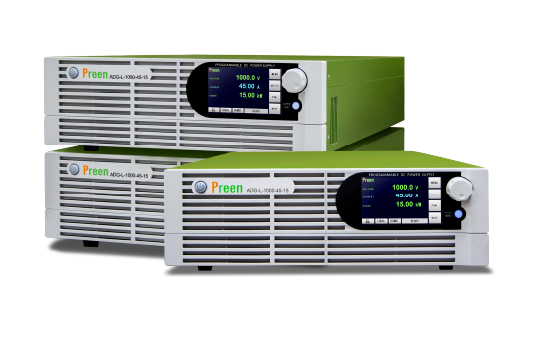
| Benchtop | Up to a few kW | R&D, design validation, education |
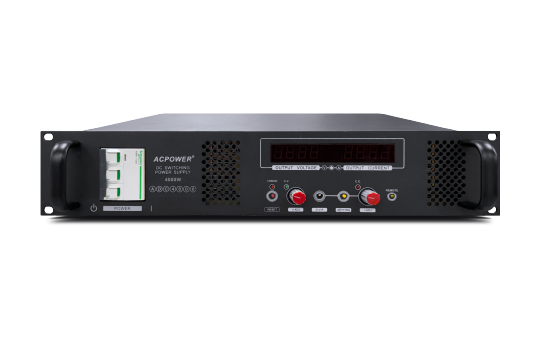
| Rack-mount | About 1 kW to tens of kW per unit, paralleled for more | Production test, ATE, burn-in racks |
| Cabinet or tower | Tens of kW to MW | EV battery packs, PV inverters, energy storage, power electronics |
More detail: rack-mount vs cabinet vs tower architectures. For Preen ranges, see ADG+ vs ADG-L and the Preen ADC rack-mount guide. For simple manual lab work, bench power supplies are usually enough.
Programmable DC Power Supplies in Australia and New Zealand
Finch is the authorised Preen distributor for Australia and New Zealand. Higher-power supplies usually need a three-phase site supply, and regenerative units feed power back into the site, so we check input power, cooling and installation with you before delivery, and provide local service and calibration support.
Not sure which supply fits? Send us your test specification and we'll recommend a configuration.
Frequently Asked Questions
What is the difference between a programmable DC power supply and a bench power supply?
A basic bench supply is set by hand and suits simple lab work. A programmable supply can be controlled from software, run voltage sequences and log measurements, which is what automated and production testing needs.
Do I need an autoranging DC power supply?
Only if your tests cover a wide range of voltages and currents. If you always test near one operating point, a conventional supply sized for that point is usually cheaper.
When should I choose a bidirectional or regenerative DC supply?
When your device returns energy, such as batteries or motor drives, or when long tests at high power would waste a lot of energy as heat.
Can I parallel DC power supplies for more power?
Many programmable supplies support master/slave paralleling. Check how many units can be combined and whether they share current accurately.
Do you supply programmable DC power supplies in New Zealand?
Yes. Finch supplies and supports Preen programmable DC power supplies across Australia and New Zealand.