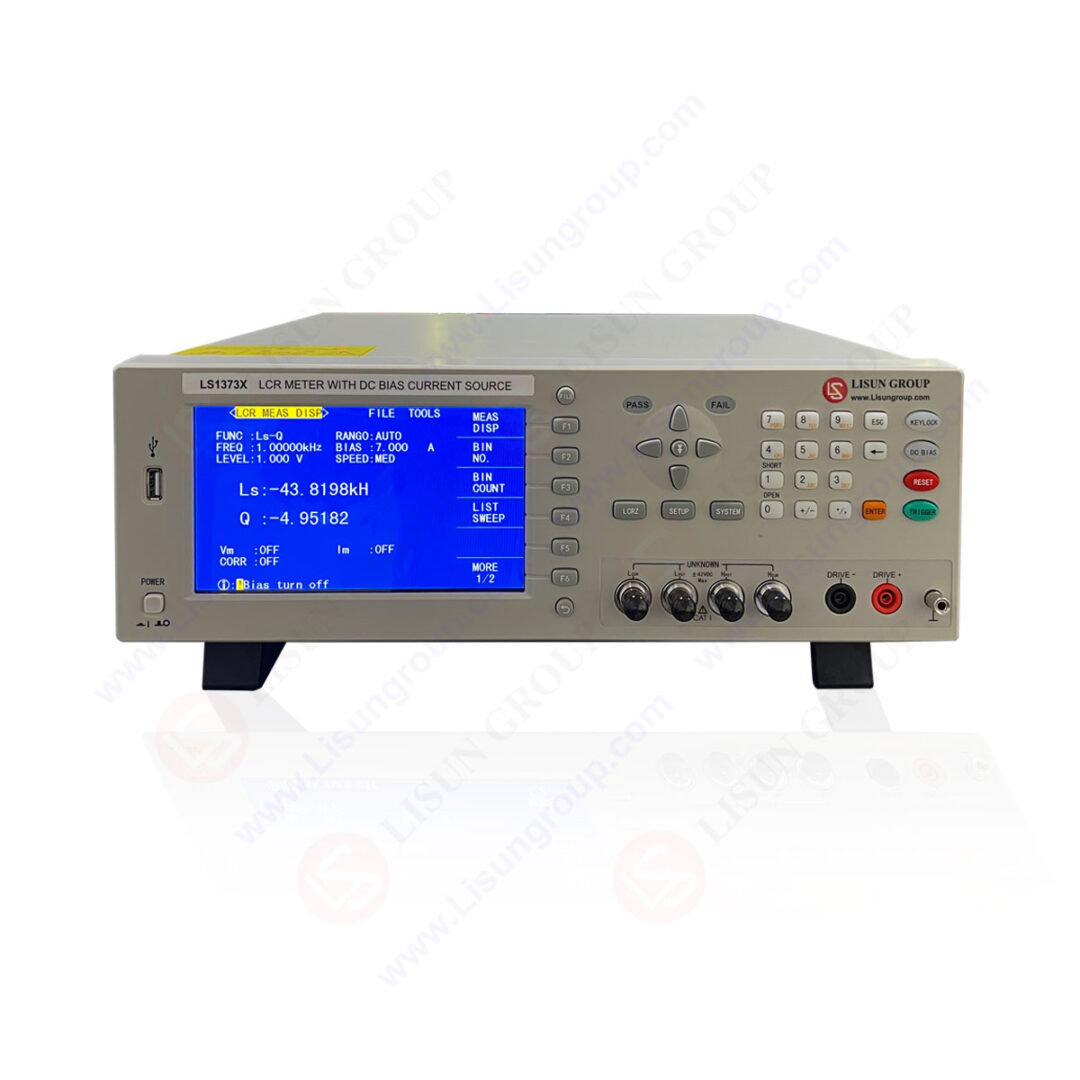
LCR Meter with DC Bias Current Source Series
LCR measurement under real operating current for inductors and transformers.
A power inductor or transformer's inductance value changes as current through it increases — core saturation effects mean the inductance measured at a small test signal level can differ meaningfully from the inductance the component actually exhibits at its real operating current. LISUN's LS1373/LS1379 Series addresses this directly: LCR measurement performed under real operating current, using an integrated DC bias current source, rather than a small-signal measurement that doesn't reflect actual in-circuit behaviour.
By applying a genuine DC bias current alongside the LCR measurement, this range measures inductance, capacitance, and resistance as the component actually behaves under load — critical for power inductors and transformers, where the whole point of characterisation is understanding performance at the current levels the component will actually see in service, not at an arbitrarily low test signal level that happens to be convenient to measure.
This distinction matters specifically because core saturation is a nonlinear effect — a component's inductance doesn't decline gradually and predictably as current increases; it can drop significantly once the core begins to saturate, and a small-signal-only measurement gives no visibility into where that saturation point sits or how the component behaves as it approaches it.
Frequently Asked Questions
Why does inductance change with applied DC current in a power inductor?
As current through an inductor increases, the magnetic core it's wound around can begin to saturate — its ability to support additional magnetic flux diminishes — causing measured inductance to decline, sometimes sharply, as current rises. This is a real, nonlinear effect that only shows up when measurement includes a genuine DC bias current at realistic operating levels.
Why can't a standard LCR meter without DC bias capability capture this behaviour?
A standard LCR meter typically applies only a small AC test signal without any substantial DC current, which measures the component's small-signal inductance but doesn't reveal how that inductance changes as real operating current is applied — missing the saturation behaviour that matters most for power inductor and transformer applications.
What applications specifically need DC-bias LCR measurement?
Power inductor and transformer characterisation where the component's real-world performance at operating current is the actual design or QC concern — switch-mode power supply inductors, power transformers, and similar magnetic components where saturation behaviour at rated current directly affects circuit performance.