Grid simulators and programmable AC power sources look similar on a spec sheet. Both produce AC power with programmable voltage and frequency, and both can add harmonics and disturbances. They are built for different jobs, though. Choosing the wrong one can either leave you unable to test the product you build or cost you a lot more than you needed to spend. This guide explains the difference, when you need each, and what to check before you buy.
The Short Answer
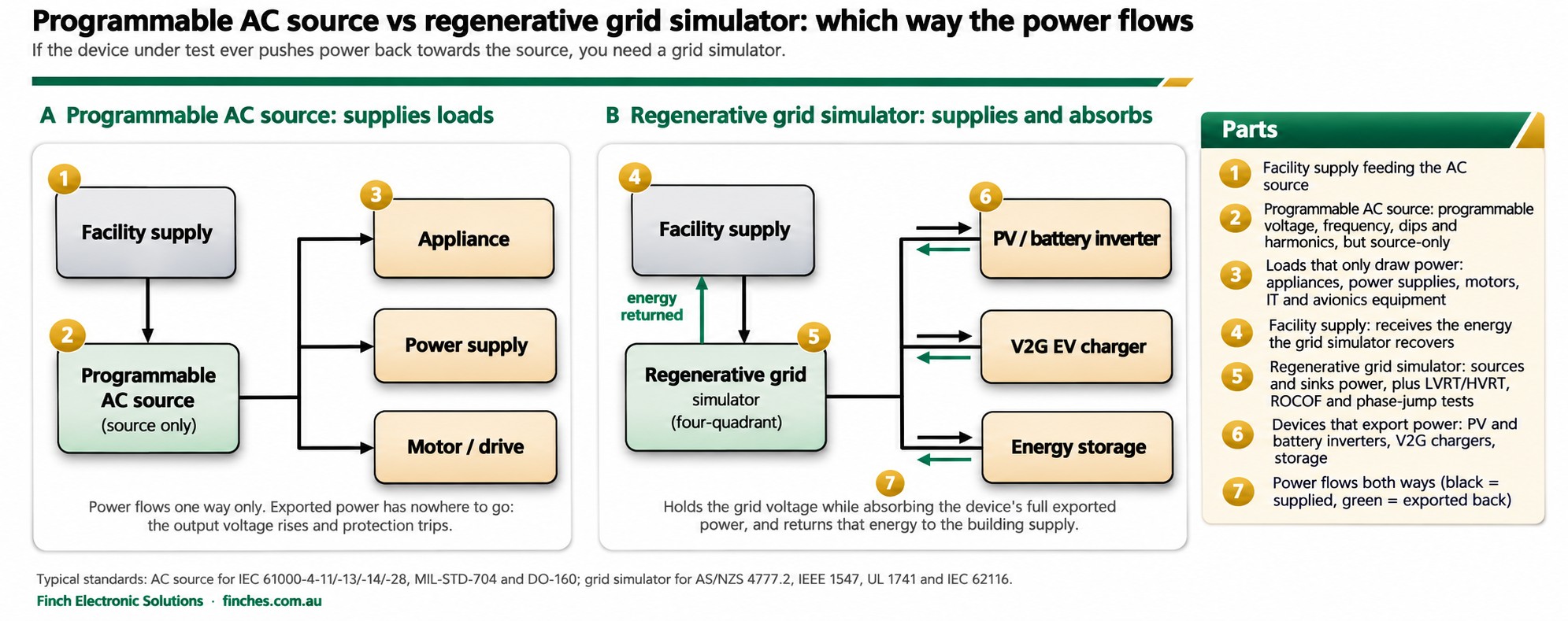
A programmable AC power source supplies power to a load. A grid simulator supplies power and also absorbs it, because it has to behave like the utility grid that a grid-connected device exports into. If your device under test ever pushes power back towards the source, as solar and battery inverters, bidirectional EV chargers, regenerative drives and microgrid controllers all do, you need a grid simulator. If it only draws power, a programmable AC source is usually the better value.
Side-by-Side Comparison
| Programmable AC Source | Grid Simulator | |
|---|---|---|
| Power flow | Source only (one or two quadrants) | Source and sink (four quadrants), regenerative |
| Typical devices under test | Appliances, power supplies, lighting, motors, IT equipment, avionics | PV and battery inverters, EV chargers (V2G), energy storage, microgrids, drives |
| Exported power | Cannot absorb it; needs external loads | Absorbs it and returns energy to the facility supply |
| Disturbance simulation | Dips, interruptions, frequency changes and harmonics for immunity testing | The same, plus LVRT/HVRT, ROCOF, phase-angle jumps and grid-code sequences |
| Line impedance emulation | Sometimes | Commonly, to reproduce weak and strong grids |
| Typical standards | IEC 61000-4-11/-4-13/-4-14/-4-28, MIL-STD-704, DO-160 | AS/NZS 4777.2, IEEE 1547, UL 1741, IEC 62116, grid codes |
| Relative cost (same kVA) | Lower | Higher, but often recovered through energy savings |
When a Programmable AC Source Is Enough
If the product under test is a load, a programmable AC source does the job well. It can supply any voltage and frequency your customers will see around the world, such as 230 V 50 Hz for Australia or 120 V 60 Hz for North America. It can also simulate the supply problems your product must tolerate: dips and interruptions to IEC 61000-4-11, frequency variation, and harmonic distortion. Linear AC sources offer very low distortion for precision work. Switch-mode sources are smaller and more efficient at higher power. For aviation, 400 Hz sources cover MIL-STD-704 and DO-160. Our guide on how to choose a programmable AC power source walks through the specifications.
When You Need a Grid Simulator
A grid-tied inverter is designed to push current into a stiff, real grid. Connect it to a unidirectional AC source and the exported power has nowhere to go. The source's output voltage rises, protection trips, and the test stops. You can add resistive loads to soak up the power, but they waste energy, generate heat, and must be retuned every time the operating point changes.
A grid simulator solves this with a regenerative, four-quadrant power stage. It holds the voltage while absorbing the inverter's full output and returns that energy to the building supply. It can then reproduce the disturbances grid codes demand: low- and high-voltage ride-through (LVRT/HVRT), frequency ramps, rate of change of frequency, phase-angle jumps and unbalanced faults. For Australian compliance, see AS/NZS 4777.2 inverter testing equipment. For ride-through testing, see the PAS-PFV regenerative grid simulator. For anti-islanding, read anti-islanding testing to IEEE 1547 and UL 1741.
The Grey Areas
- Regenerative loads: motors and drives that occasionally regenerate during braking can sometimes be handled by an AC source with limited sink capability. Check the regenerative rating rather than assuming.
- Hardware-in-the-loop: when an AC source or grid simulator acts as an amplifier for a real-time simulator, bandwidth and latency matter more than raw power. See HIL vs PHIL vs CHIL.
- One instrument for both: many modern grid simulators also work as high-performance programmable AC sources. If your lab tests both loads and inverters, one grid simulator may cover both, though it will cost more than an AC source on its own.
Questions to Ask Before You Buy
- Does any device I test export power, now or in the next five years?
- Which standards do I need to test to, and do they require ride-through, ROCOF or phase-jump sequences?
- What is the largest single-phase and three-phase power I need, and do I need independent per-phase control?
- How much energy will full-power tests use, and what will the heat load cost in the lab?
- Do I need line-impedance emulation or a real-time control interface for HIL?
Browse our grid simulators and programmable AC power sources, or see the full range of programmable power supplies supplied and supported in Australia by Finch.
Frequently Asked Questions
What is the difference between a grid simulator and a programmable AC power source? A programmable AC power source supplies AC power to a load at a programmable voltage and frequency. A grid simulator is a programmable AC source that can also absorb power fed back into it (regenerative, four-quadrant operation) and reproduce grid disturbances, so it can stand in for the utility grid when testing inverters, chargers and other grid-connected equipment.
Can a programmable AC source test a solar inverter? Not on its own for full-power tests. A grid-tied inverter exports power, and a unidirectional AC source cannot absorb it. You would need large resistive loads in parallel, which is wasteful and limits the tests you can run. A regenerative grid simulator is the standard choice for inverter testing.
When is a programmable AC source the right choice? When the device under test only consumes power: appliances, power supplies, motors, lighting, and equipment tested for EMC immunity to voltage dips and interruptions, frequency variation or harmonics. These tests need a clean, programmable supply but no power absorption.
What does four-quadrant mean? Four-quadrant operation means the source can supply or absorb both real and reactive power, at any combination of voltage and current polarity. It lets a grid simulator act like a real grid, which both supplies and absorbs power.
Is a grid simulator more expensive than an AC source? Usually yes at the same power rating, because of the regenerative power stage. For inverter, EV charger and battery-storage testing it normally pays back through lower energy costs, less heat load and the ability to run full-power tests that would otherwise be impractical.