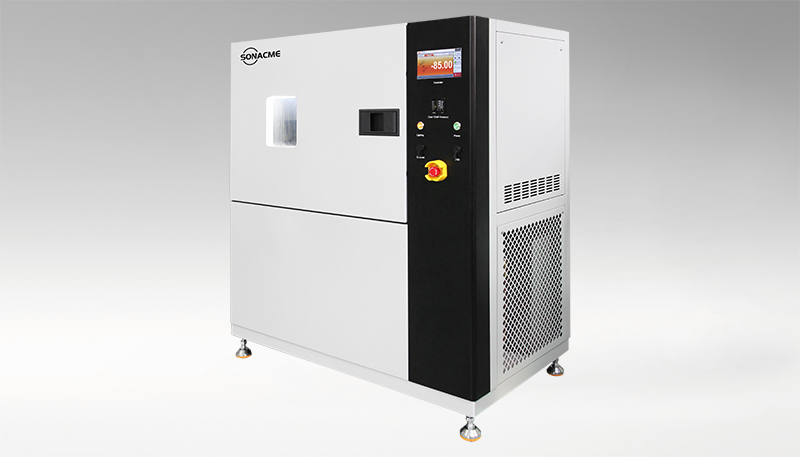
Ultra Low Temperature Chambers
Extended-Range Cold Testing Down to -85°C for Temperature Characteristic and Storage Testing
Most industrial temperature chambers cover down to around -40°C to -55°C, which is enough for general product qualification but falls short of what aerospace, defence, and specialised electronics work actually requires. Components destined for high-altitude flight, satellite payloads, or cold-region military deployment are routinely specified to survive storage or operation down toward -85°C — a range standard chamber ranges simply aren't built to reach. Sonacme's ultra low temperature chambers extend the cold end specifically for this purpose, without giving up the +180°C high-temperature capability needed for the other end of a qualification programme.
Two range options are available: -85°C to +180°C, and -75°C to +180°C. Both are used for two related but distinct test purposes — temperature characteristic testing, which evaluates how a product's electrical or mechanical performance changes as temperature drops, and low-temperature storage testing, which confirms a product survives extended dwell time at its rated minimum storage temperature without physical or material degradation once returned to normal conditions.
Reaching -85°C reliably, rather than just briefly touching it, depends on chamber construction as much as refrigeration capacity. These chambers use fully-welded 1.0mm SUS304 stainless steel interiors to eliminate seams that would otherwise become cold bridges and condensation points, a double silicon rubber door seal to maintain the pressure and thermal boundary at extreme cold, and a four-layer tempered glass observation window with an anti-frosting heater — without heated glass, a window at this temperature range fogs and ices over almost immediately, making visual monitoring of the test article impossible.
Choosing between the two range options comes down to what the test specification actually calls for. If a project's coldest requirement sits above -75°C with margin, the -75°C model covers the same +180°C high-temperature range at a simpler specification. Where a standard or customer requirement calls for qualification at or near -85°C specifically — common in aerospace and defence storage specifications — only the -85°C model provides the necessary margin.