Home /
This is some text inside of a div block.
Programmable Power Supplies

Preen PAS/PFV Series

Regenerative Grid Simulator, PAS up to 2000kVA / PFV up to 400kVA

Testing solar inverters, EV chargers, and other grid-tie devices properly means testing how they behave when the grid itself misbehaves — voltage sags, surges, and the disturbances a real utility grid occasionally produces. A conventional AC source can supply power to a device under test, but only a four-quadrant regenerative source can also sink power back from it, reproducing the genuine two-way power flow that grid-tie equipment actually experiences in service.

Preen's PAS/PFV series delivers exactly that: sourcing power to a test article and sinking it back to the grid at over 90% efficiency, rather than dissipating returned energy as waste heat the way a non-regenerative load would. PAS models scale up to 2000kVA for large-scale grid-tie and utility-adjacent testing, while PFV models cover up to 400kVA for smaller inverter and charger qualification work. Both include built-in Low Voltage Ride Through (LVRT) and High Voltage Ride Through (HVRT) simulation, supporting compliance testing against IEEE 1547.1 and BDEW grid-code requirements — standards that specifically govern how grid-tie equipment must behave during voltage disturbances rather than simply disconnecting.

An optional harmonics waveform synthesis function generates up to 25 programmable harmonics, letting a test programme evaluate device behaviour under distorted grid conditions in addition to clean sinusoidal supply. Baseline performance is tight regardless — THD ≤1%, load regulation ≤1% into a resistive load, and input power factor ≥0.99 — important for ensuring the test system itself isn't introducing measurement uncertainty into compliance-critical grid-code testing.
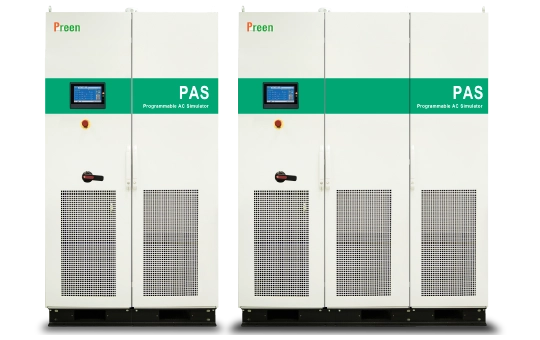
Preen PAS PFV Series regenerative grid simulator
Inquire About This Range →
PAS/PFV Series
Available as a Containerized / IP54 Option
Like Preen's BPS shore power series, the PAS/PFV Series can be built into a customized outdoor container or upgraded to an IP54-rated enclosure as an optional configuration — useful for ports, construction sites, remote installations, and other high humidity, heat, dust, or corrosion-exposed environments. Standard indoor chassis remain the default; contact Finch to configure a containerized or IP54 version for your application.
Preen PAS Series regenerative grid simulator

PAS-F Series — With Voltage Ride-Through (LVRT/HVRT), 30-1000kVA

Four-quadrant regenerative grid simulator with built-in LVRT and HVRT test modes for IEEE 1547.1 and BDEW grid-code compliance. Over 90% source/sink efficiency.
Enquire About This Series →

Technical Specifications

Output Power RangePAS Series: 30kVA–2000kVA (Ordering info to 1000kVA shown) · PFV Series: 30kVA–400kVA
Output Voltage RangePFV Series: 0–150.0V(L-N) or 0–300.0V(L-N) · PAS-F Series: 0–300.0V(L-N), 0–350V opt.
Output Frequency RangeStandard 45–65Hz · Optional 40–70Hz
Line Regulation≤ 1%
Load Regulation≤ 1% (Resistive Load)
Total Harmonic Distortion (THD)≤ 2% (Resistive Load)
Response Time≤ 2ms
Crest Factor≥ 3
Efficiency≥ 92% at max. power
Regenerative FunctionYes – four-quadrant operation, sinks power from EUT back to the grid at over 90% efficiency
Voltage Ride Through (VRT)PAS Series: Yes (LVRT & HVRT per IEEE Std 1547.1-2020) · PFV Series: No
Three-Phase Independent AdjustmentYes, including phase angle setting
Harmonics Editor2–25th order (PAS series, optional)
Standard FeaturesSynchronized 5V DC signal output, GRADUAL & STEP voltage/frequency simulation modes
ProtectionsInput: N.F.B., Over/Under Voltage · Output: Over Voltage, Over Current, Reverse Current, Over Temperature
Remote InterfacesStandard: RS-485, RS-232 · Optional: GPIB, Ethernet, USB
HMITouch screen
Operating Temperature0°C to 45°C
Humidity0–90% (non-condensing)
Altitude< 1,500m
ModelPower 
PAS-F-3303030kVAEnquire
PAS-F-3304545kVAEnquire
PAS-F-3306060kVAEnquire
PAS-F-3307575kVAEnquire
PAS-F-33100100kVAEnquire
PAS-F-33120120kVAEnquire
PAS-F-33150150kVAEnquire
PAS-F-33200200kVAEnquire
PAS-F-33300300kVAEnquire
PAS-F-33400400kVAEnquire
PAS-F-33600600kVAEnquire
PAS-F-33800800kVAEnquire
PAS-F-3310001000kVAEnquire
Preen PFV Series regenerative AC source

PFV Series — Regenerative Function, No VRT, 30-400kVA

Four-quadrant regenerative AC power source with the same >90% source/sink efficiency as PAS-F, but without built-in Voltage Ride-Through test modes — a more cost-effective option where LVRT/HVRT simulation isn't required.
Enquire About This Series →
ModelPower 
PFV-3303030kVAEnquire
PFV-3304545kVAEnquire
PFV-3306060kVAEnquire
PFV-3307575kVAEnquire
PFV-33100100kVAEnquire
PFV-33120120kVAEnquire
PFV-33150150kVAEnquire
PFV-33200200kVAEnquire
PFV-33300300kVAEnquire
PFV-33400400kVAEnquire

Frequently Asked Questions

What's the practical difference between LVRT and HVRT testing?
LVRT (Low Voltage Ride Through) testing verifies a grid-tie device continues operating correctly during a voltage sag rather than disconnecting immediately — required behaviour under most modern grid codes, since widespread disconnection during a grid disturbance can worsen the disturbance. HVRT (High Voltage Ride Through) tests the equivalent behaviour during a voltage surge. Both are standard requirements for solar inverters and other grid-connected equipment under IEEE 1547.1 and similar standards.
Should I choose PAS or PFV for my testing programme?
PAS scales to significantly higher power (2000kVA), suited to large-scale or utility-adjacent testing. PFV covers up to 400kVA, appropriate for most inverter and EV charger qualification work at a smaller scale. The choice generally comes down to the power rating of the devices under test.
Why does regenerative (four-quadrant) operation matter versus a standard AC source plus separate load?
A standard AC source alone can't sink power back from a device under test, so testing genuine bidirectional grid-tie behaviour would otherwise require a separate load bank, adding complexity and typically wasting the returned energy as heat. Four-quadrant regenerative operation handles both source and sink functions in one instrument, recovering the energy at high efficiency rather than dissipating it.
Send an Enquiry →Send an Enquiry →

Related Reading