Which Cleaver or Prep Tool Do I Need?
Start with the job, then compare the models in that group. Click a model to jump to its full specifications.
| Your job | Go to | Models | Choose by |
|---|
| Splicing standard single-mode or multimode fibre | Precision cleavers | X50, X-50B, X-50C, X-50D, X55B | Operation and blade life |
| PM, large diameter or small diameter fibre | Specialty cleavers | X50F, LDC-100, XFC-01, SFC-10 | Cladding diameter |
| Stripping ribbon or single fibre, recoating splices | Strippers and recoater | X-17, X-18, Three-hole stripper, FR-100 | Fibre type |
| Equipping a crew or a new technician | Tool kits | X-20B, X-20C, SH90 | What you already own |
Precision Cleavers for 125 µm Fibre
Hand-held cleavers for standard single-mode and multimode fibre, from compact manual models to automatic blade rotation.
Enquire About These Cleavers →Which model do I need?
All five cleave 125 µm fibre with 0.25–0.9 mm coating. Choose by how you work. For ribbon as well as single fibre, choose the X50 or X-50B, which take exchangeable holders. The X-50D is the lightest at 210 g and semi-automatic. The X55B rotates the blade and collects the scrap fibre on every cleave, which suits high-volume splicing and gives the longest blade life. The X-50C is a compact mini cleaver; ask us for its full figures.
| Model | Operation | Ribbon fibre | Cleave angle | Blade life | Weight |
|---|
| X50 | Manual | Yes (exchangeable) | 0.5° | 48,000 cleaves | 257 g |
| X-50B | Manual, quick-cutting | Yes (exchangeable) | 0.7° | 48,000 cleaves | 380 g |
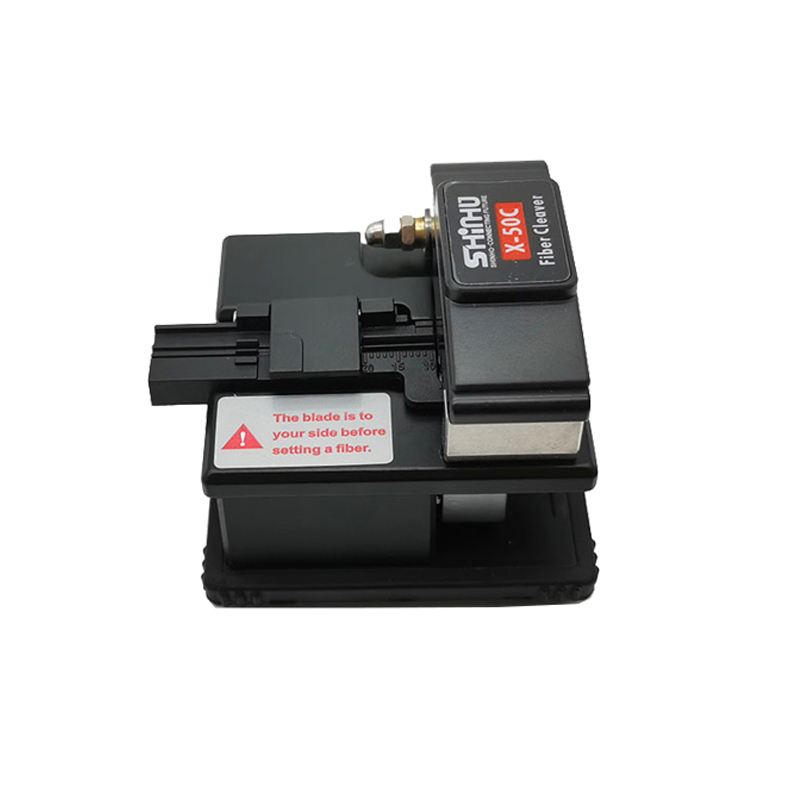
| X-50C | Not stated | Not stated | Not stated | 48,000 cleaves | Not stated |
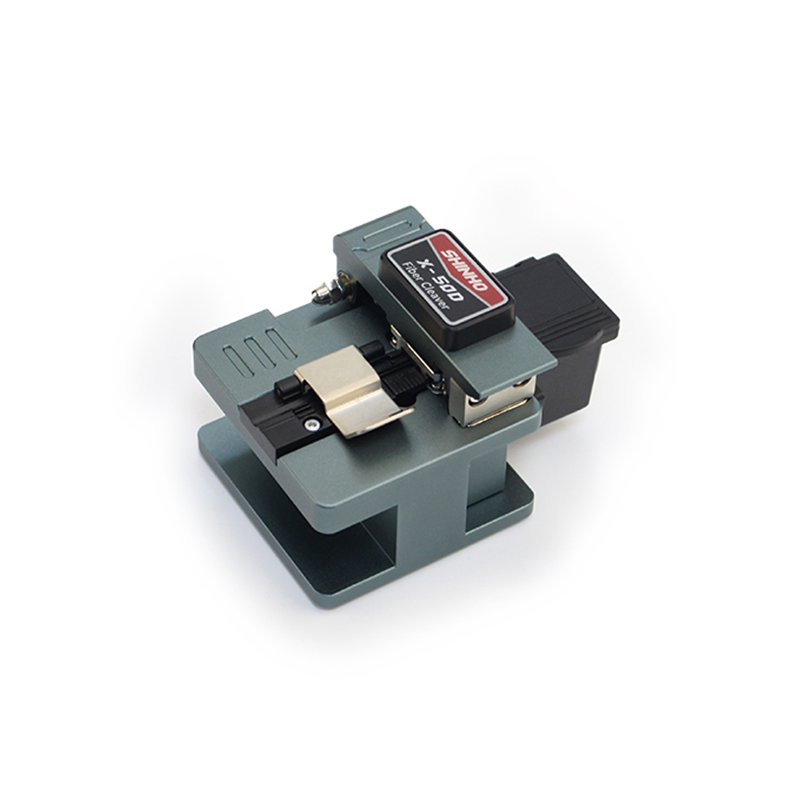
| X-50D | Semi-automatic | No | 0.5° | 48,000 cleaves | 210 g |
| X55B | Automatic blade rotation and scrap collection | No | 0.5° or better | 60,000 cleaves | 340 g |
Full specifications
Scroll sideways to see every model.
| | X50mini · manual | X-50Bquick-cutting · ribbon | X-50Cmini | X-50Dsemi-automatic · 210 g | X55Bautomatic · 60,000 cleaves |
|---|
| Type | Mini precision cleaver, manual | Quick-cutting precision cleaver, manual | Mini precision cleaver | Mini precision cleaver, semi-automatic | Automatic cleaver with automatic blade rotation and scrap collection |
|---|
| Fibre | 125 µm cladding; single fibre or ribbon (exchangeable) | 125 µm cladding; single fibre or ribbon (exchangeable) | 125 µm cladding | 125 µm cladding; single fibre | 125 µm cladding; single fibre |
|---|
| Coating diameter | 0.25–0.9 mm |
|---|
| Cleave length | 5–16 mm | 5–20 mm | 5–20 mm | 5–20 mm | 5–16 mm |
|---|
| Cleave angle | 0.5° | 0.7° | Not stated | 0.5° | 0.5° or better |
|---|
| Blade | 48,000 cleaves | 48,000 cleaves | 48,000 cleaves | 48,000 cleaves | 60,000 cleaves |
|---|
| Dimensions | 63 × 89 × 54 mm | 84 × 93 × 62 mm | Not stated | 67 × 84 × 58 mm | 140 × 93 × 55 mm |
|---|
| Weight | 257 g | 380 g | Not stated | 210 g | 340 g |
|---|
| Supplied with | Carrying case, user manual | Carrying case, user manual | — | Carrying box, screwdriver | Carrying case, screwdriver, user manual |
|---|
| Enquire | Ask about the X50 → | Ask about the X-50B → | Ask about the X-50C → | Ask about the X-50D → | Ask about the X55B → |
|---|
Specialty Cleavers: PM, Large and Small Diameter Fibre
For fibre a standard 125 µm cleaver cannot handle, from 40 µm to 1,250 µm cladding.
Enquire About These Cleavers →Which model do I need?
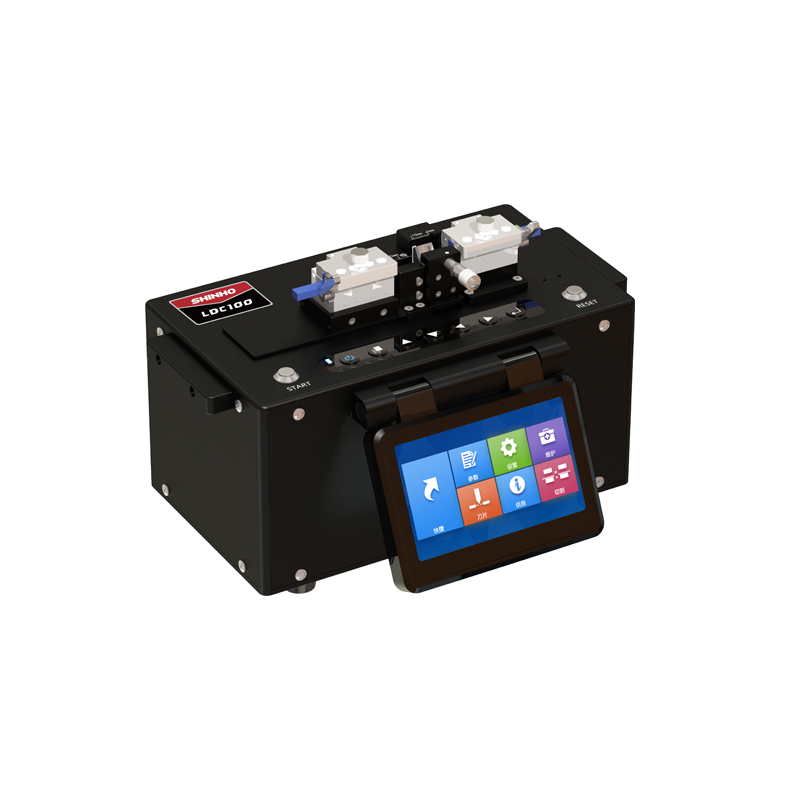
Choose by cladding diameter. For PM fibre at 125 µm, the X50F is a hand-held cleaver set up for PM work. Large diameter and laser fibre needs a tension-and-score cleaver: the XFC-01 is portable and battery powered for 125–250 µm, and the LDC-100 covers 80–1,250 µm with vacuum clamping, 40 programs and a touch screen. For small diameter fibre (40–80 µm), the SFC-10 uses ultrasonic vibration. These pair with the large diameter and specialty splicers.
| Model | Fibre | Cladding diameter | Cleave angle | Method | Weight |
|---|
| X50F | PM fibre | 125 µm | 0.7° | Manual blade | 380 g |
| LDC-100 | Large diameter, including PM | 80–1,250 µm | Typical 0.5° | Tension and diamond score, touch screen | 4.37 kg |
| XFC-01 | Large diameter | 125–250 µm | Typical 0.5° | Tension and diamond score, battery | 1.97 kg |
| SFC-10 | Small diameter | 40–80 µm | 0.5° | Tension and ultrasonic vibration | 2.1 kg |
Full specifications
Scroll sideways to see every model.
| | X50FPM fibre · manual | LDC-10080–1,250 µm | XFC-01125–250 µm · portable | SFC-1040–80 µm · ultrasonic |
|---|
| Type | Precision cleaver for PM fibre, manual | Large diameter fibre cleaver, tension-and-score, touch screen | Compact large diameter fibre cleaver, tension-and-score | Ultrasonic cleaver for small diameter fibre |
|---|
| Fibre | 125 µm cladding; single fibre or ribbon (exchangeable) | 80–1,250 µm cladding; single fibre; PM (Panda, bow-tie, elliptical) | 125–250 µm cladding; single fibre | 40–80 µm cladding |
|---|
| Coating diameter | 0.25–0.9 mm | 160–3,000 µm | 250–400 µm | 50–160 µm |
|---|
| Cleave length | 5–20 mm | 5–40 mm | 2–30 mm | 5–20 mm |
|---|
| Cleave angle | 0.7° | Typical 0.5° | Typical 0.5° | 0.5° |
|---|
| Fibre clamping | — | Vacuum-assisted V-groove | — | — |
|---|
| Blade | 48,000 cleaves | Diamond, 10 positions, about 20,000 cleaves (125 µm fibre) | Diamond, 10 positions × 1,000 cleaves (250 µm fibre) | Diamond, 10 positions × 2,000 cleaves |
|---|
| Programs / storage | — | 40 modes / 4,000 cleave records | — | — |
|---|
| Display | — | 5.0-inch HD colour touch screen | — | — |
|---|
| Battery | — | 3,400 mAh, up to 8 hours (about 600 cleaves) | Pluggable, about 700 cleaves per charge | 3,400 mAh, about 600 cleaves |
|---|
| Interface | — | USB 2.0 | — | — |
|---|
| Operating temperature | Not stated | 0 to +40 °C | 0 to +40 °C | Not stated |
|---|
| Dimensions | 84 × 93 × 62 mm | 270 × 155 × 165 mm | 168 × 111 × 116 mm | 212 × 142 × 91 mm |
|---|
| Weight | 380 g | 4.37 kg | 1.97 kg with battery | 2.1 kg with battery |
|---|
| Supplied with | Scrap collector, screwdriver, carrying bag, user manual | Six fibre inserts (200–750 µm), microscope, tools, power adapter | — | — |
|---|
| Method | — | — | — | Tension (50–160 g, adjustable) plus ultrasonic vibration |
|---|
| Cleave time | — | — | — | Typical 10 s |
|---|
| Enquire | Ask about the X50F → | Ask about the LDC-100 → | Ask about the XFC-01 → | Ask about the SFC-10 → |
|---|
Which model do I need?
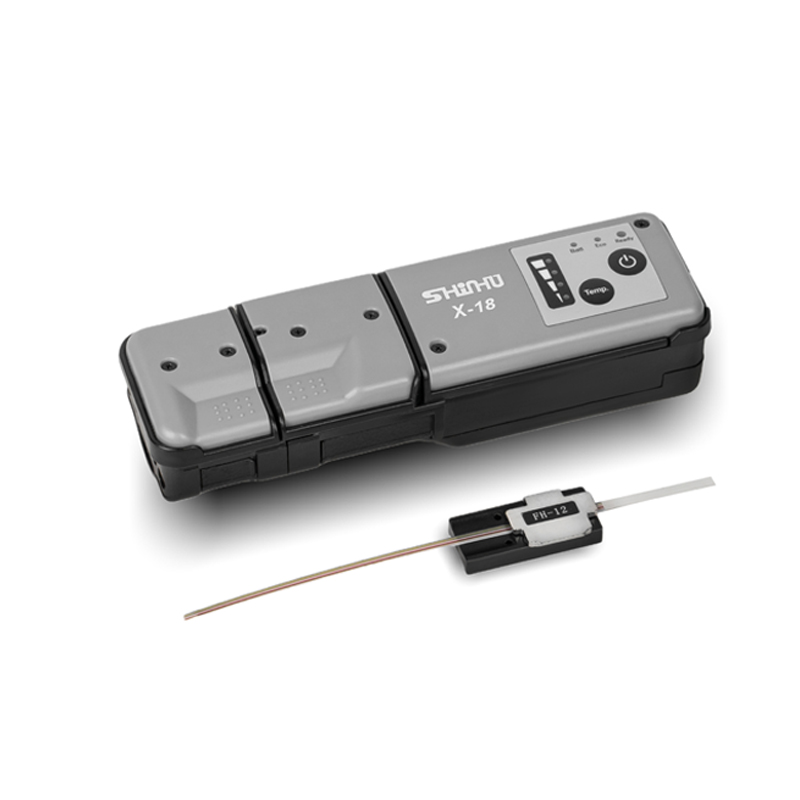
For ribbon fibre, use a thermal stripper, which softens the coating so the whole ribbon strips in one pull without damaging the glass. The X-17 heats fastest; the X-18 has the larger battery and needs less force. The three-hole stripper is the everyday hand tool for single fibres. The FR-100 recoats a splice to the original diameter instead of using a heat-shrink sleeve, for fibre lasers, sensors and other work where the fibre has to stay flexible; the FR-101 version adds a proof tester.
| Model | Type | Fibre | Strip or recoat | Battery | Weight |
|---|
| X-17 | Thermal stripper | Single and up to 12-fibre ribbon | Up to 30 mm, 4–5 s heat | 800 mAh, 300+ strips | 300 g |
| X-18 | Thermal stripper | Single and up to 12-fibre ribbon | Up to 30 mm, 10 s heat | 2,000 mAh, about 600 strips | 267 g |
| Three-hole stripper | Hand stripper | 250 µm, 900 µm, 3 mm | Coating, buffer and jacket | — | 119 g |
| FR-100 | UV recoater (FR-101 adds proof test) | Single fibre, acrylate | 195–1,000 µm, 4–50 mm | Not stated | 4.3 kg |
thermal · 4 sX-17
| Type | Thermal stripper, single fibre and ribbon |
|---|
| Fibre | 125 µm cladding; single fibre or 2–12 fibre ribbon |
|---|
| Coating diameter | 0.25–0.4 mm (single); 0.3–0.4 mm (ribbon) |
|---|
| Strip length | Up to 30 mm |
|---|
| Heating time | 4–5 s (normal mode) |
|---|
| Temperatures | 80, 95, 110, 130 °C (normal); 70–110 °C (power saving) |
|---|
| Fibre holders | FH-2 to FH-12, FH-250, FH-900, FH-U |
|---|
| Battery | 800 mAh, more than 300 strips per charge |
|---|
| Operating temperature | 0 to +40 °C |
|---|
| Dimensions | 138 × 34.5 × 35 mm |
|---|
| Weight | 300 g with battery |
|---|
Ask about the X-17 →
thermal · 2,000 mAhX-18
| Type | Thermal stripper, single fibre and ribbon |
|---|
| Fibre | 125 µm cladding; single fibre or 2–12 fibre ribbon |
|---|
| Coating diameter | 0.25–0.4 mm (single); 0.3–0.4 mm (ribbon) |
|---|
| Strip length | Up to 30 mm |
|---|
| Heating time | 10 s first strip (normal mode) |
|---|
| Temperatures | 60, 80, 100, 120 °C |
|---|
| Fibre holders | FH-2 to FH-12 |
|---|
| Battery | 2,000 mAh, about 600 strips per charge |
|---|
| Operating temperature | 0 to +40 °C |
|---|
| Dimensions | 155 × 50 × 40 mm |
|---|
| Weight | 267 g with battery |
|---|
| Supplied with | Carrying case, AC adapter, cleaning brush |
|---|
Ask about the X-18 →
hand stripperThree-hole stripper
| Type | Three-hole hand stripper |
|---|
| Strips | 250 µm coating, 900 µm buffer, 3.0 mm jacket |
|---|
| Jaws | Hardened, laser-drilled holes |
|---|
| Handle | Cushioned grip, locks closed |
|---|
| Length | 165 mm |
|---|
| Weight | 119 g |
|---|
Ask about the three-hole stripper →
automatic recoaterFR-100
| Type | Automatic fibre recoater, UV LED curing (FR-101 adds a proof tester) |
|---|
| Fibre | Single fibre, acrylate coating |
|---|
| Recoat diameters | 195–1,000 µm (quartz moulds) |
|---|
| Recoat length | 4–50 mm |
|---|
| Cure time | 20 s resin injection, 4 s cure |
|---|
| Programs / storage | 50 coating, 40 proof / 2,000 records |
|---|
| Proof test | FR-101: 0.2–2.0 kgf |
|---|
| Operating temperature | +10 to +30 °C |
|---|
| Dimensions | 250 × 170 × 176 mm |
|---|
| Weight | 4.3 kg (FR-101: 4.8 kg) |
|---|
Ask about the FR-100 →
Which model do I need?
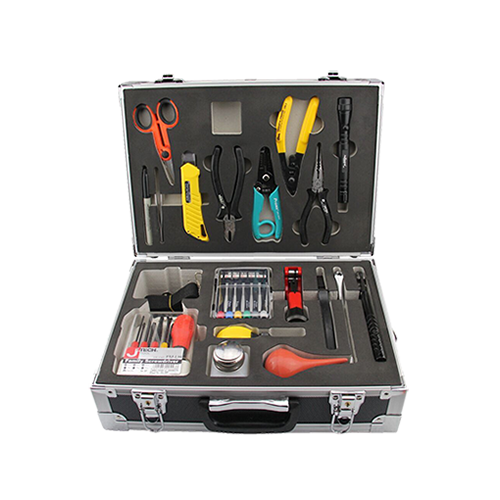
Choose by what you already own. The X-20B is a preparation kit to go with your own splicer and cleaver. The X-20C adds consumables such as cleaning wipes, swabs, splice sleeves and furcation tubing, for termination and general work. The SH90 is a complete set-up in one large case, including a fusion splicer and power meter as well as power and electrical tools; ask us which splicer it ships with.
| Model | Kit for | Items | Includes | Case |
|---|
| X-20B | Cable sheath removal and fusion splicing | 22 | Hand tools, strippers, cutters, cleaning | 385 × 275 × 110 mm |
| X-20C | General fibre work and termination | 27 | Strippers, cutters, cleaning, sleeves, furcation | 425 × 350 × 155 mm |
| SH90 | Complete splicing and installation | 26 | Fusion splicer, power meter, drill, multimeter | 960 × 731 × 264 mm |
splicing prep · 22 itemsX-20B
| Type | Fusion splicing tool kit |
|---|
| Items | 22 |
|---|
| Fibre prep | CFS-2 fibre stripper, Kevlar scissors, buffer tube slitter, round cable cutter, steel wire rope cutter |
|---|
| Hand tools | Lineman’s, needle-nose and side-cut pliers, 8-inch adjustable wrench, 4 screwdrivers, 6-piece electronic screwdriver set, utility knife |
|---|
| Cleaning and other | Alcohol bottle, blow brush, tweezers, tape measure, marker, LED torch |
|---|
| Case | 385 × 275 × 110 mm |
|---|
Ask about the X-20B →
basic fibre kitX-20C
| Type | Basic fibre optic tool kit |
|---|
| Items | 27 (including case) |
|---|
| Fibre prep | Tri-hole stripper, Kevlar scissors, jacket, buffer tube and round cable strippers, compound cutter, fibre disposal unit |
|---|
| Hand tools | Needle-nose pliers, 4-bit screwdriver, ½-inch nut driver, utility knife, ruler, tweezers |
|---|
| Consumables | Cleaning platform (120 wipes), 65 swabs, 50 × 60 mm splice sleeves, shrink tube kit, 3 mm and 900 µm furcation, labels, tape |
|---|
| Also | Safety glasses, work mat |
|---|
| Case | Rugged case, 425 × 350 × 155 mm |
|---|
Ask about the X-20C →
complete kit · with splicerSH90
| Type | Full splicing and installation kit, including a fusion splicer |
|---|
| Items | 26 |
|---|
| Fibre and test | Fusion splicer, fibre stripper, power meter |
|---|
| Power tools | Impact drill with 2 batteries, drill bit set |
|---|
| Electrical | Multimeter, voltage tester, soldering iron and stand, solder, crimp pliers |
|---|
| Hand tools | Pliers, socket and adjustable wrenches, screwdrivers, hex set, hammer, scissors, utility knife, tape measure, tweezers, torch |
|---|
| Case | 960 × 731 × 264 mm |
|---|
Ask about the SH90 →
Why the Cleave Matters
A splicer can only be as good as the fibre ends it is given. A cleave angle of 0.5° or better and a clean, mirror-flat end-face are what make a low-loss splice possible; a chipped or angled cleave shows up as high loss or a rejected splice. Strip cleanly, clean the bare fibre, cleave, and splice straight away.
What to Check When Choosing a Cleaver
- Fibre range. Cladding and coating diameter, and whether it takes ribbon. Standard cleavers cover 125 µm with 0.25–0.9 mm coating.
- Cleave angle. Typically 0.5°; lower is better for core-alignment and specialty splicing.
- Blade life and replacement. 48,000 cleaves on most hand-held models and 60,000 on the X55B; large diameter cleavers quote cleaves per blade position.
- Cleave length. Match it to your splicer’s fibre holders, usually 5–16 mm or 5–20 mm.
- Scrap collection. Loose fibre offcuts are a safety hazard; a cleaver that collects them saves a step.
Fibre Cleavers in Australia and New Zealand
Finch is the Australian distributor for XHFiber (SHINHO) and supplies cleavers, strippers and tool kits to telecom, NBN and FTTx contractors, fibre laser manufacturers and research labs across Australia and New Zealand, with local technical support. See also fusion splicers, OTDRs and test instruments and inspection, identification and cleaning tools.
Not sure which cleaver suits your fibre? Tell us the fibre type and diameter and we will recommend one.
Frequently Asked Questions
Why does cleave quality matter for splice loss?
The splicer fuses whatever end-faces it is given. A cleave angle outside about 0.5°, or a chipped or hackled end-face, leads to higher loss or a rejected splice however good the splicer is.
Which cleaver do I need for ribbon fibre?
A cleaver with exchangeable holders, such as the X50 or X-50B, cleaves single fibre and ribbon. Strip ribbon with a thermal stripper such as the X-17 or X-18 first.
Can a standard cleaver cut large diameter fibre?
No. Standard cleavers are made for 125 µm cladding. Larger fibre needs a tension-and-score cleaver such as the XFC-01 (125–250 µm) or LDC-100 (80–1,250 µm), and small 40–80 µm fibre needs the SFC-10.
Why use a thermal stripper?
Heating softens the coating so it comes away in one pull, with less force on the glass and less risk of nicking it. It is the usual way to strip ribbon fibre, where a hand stripper cannot do all the fibres at once.
Do you supply fibre cleavers in New Zealand?
Yes. Finch supplies and supports SHINHO cleavers and fibre preparation tools across Australia and New Zealand.