DO160-S17 Voltage Spike Generator (RTCA DO-160) – LISUN
LISUN DO160-S17 voltage spike generators for RTCA DO-160 Section 17 avionics tests: 5V to 1000V, 10μs spikes, 50Ω, coupling for 16A, 50A or 100A power lines.
Enquire About This Product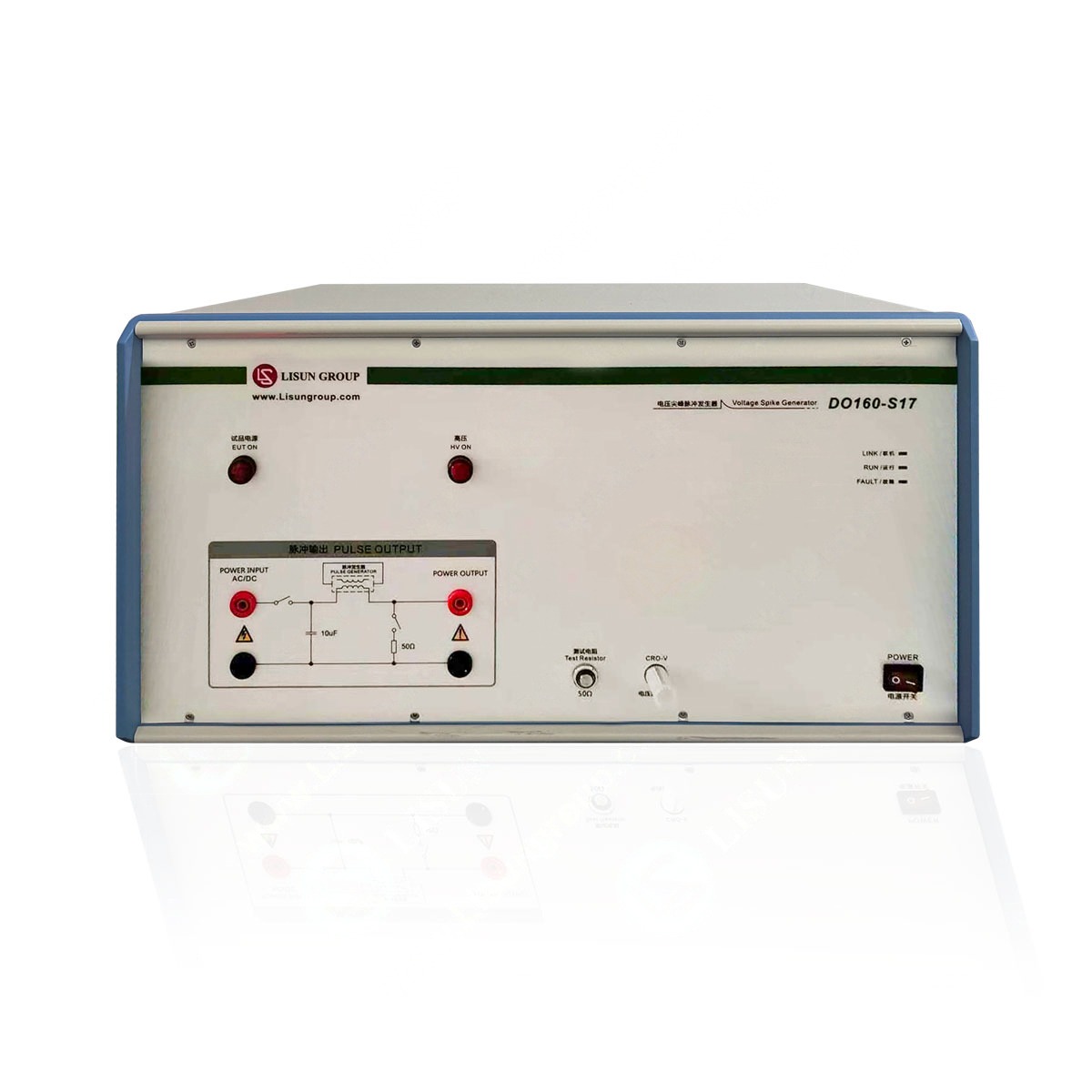
Overview
Switching loads and relays on an aircraft's power bus produce short voltage spikes. RTCA DO-160 Section 17 tests whether airborne equipment survives them on its AC and DC power inputs.
The DO160-S17 generates the Section 17 spike waveform, with rise time of 2μs or less and pulse width over 10μs, from a 50Ω source, at amplitudes from 5V to 1000V and the repetition rates set by the standard. The base model couples onto power lines up to 440V/16A through a built-in network; the 50A and 100A versions use an external 10μs coupling transformer. Tests are set up with one key and run automatically, with data storage and report export. A smart Android system allows remote control over Wi-Fi from a tablet.
For CS106 spike testing to MIL-STD-461F or GJB 151 on ship and submarine equipment, LISUN offers the LIS-CS106-50A power line spike generator.
Key Specifications
| Specification | DO160-S17 | DO160-S17-50A | DO160-S17-100A |
|---|---|---|---|
| Coupling | Built-in CDN, max 440V/16A | External 10μs coupling transformer, max 440V/50A | External 10μs coupling transformer, max 440V/100A |
| Test voltage | 5~1000V, continuously adjustable | ||
| Rise time | ≤2μs | ||
| Pulse width | >10μs | ||
| Source impedance | 50Ω ±10% | ||
| Polarity | Positive, negative, alternating | ||
| Trigger | Automatic | ||
Features
- RTCA DO-160 Section 17 spike waveform
- 5V to 1000V
- 16A, 50A and 100A coupling options
- Automatic testing and report export
- Wi-Fi tablet remote control
Applications
- Civil avionics equipment
- Military avionics
- Aircraft power supply units
Frequently asked questions
Which model do I need?
Choose by the current drawn by the equipment under test: 16A with the built-in network, or 50A and 100A with the external coupling transformer.
Does it cover MIL-STD-461 CS106?
No. For CS106, LISUN offers the LIS-CS106-50A.