CD-626, CD-628 and CD-630 Colour Densitometers – LISUN
LISUN CD-626/628/630 colour densitometers for print: density, tone value, trapping and 30+ colour indices, dE*ab≤0.02 repeatability, ColorExpert software.
Enquire About This Product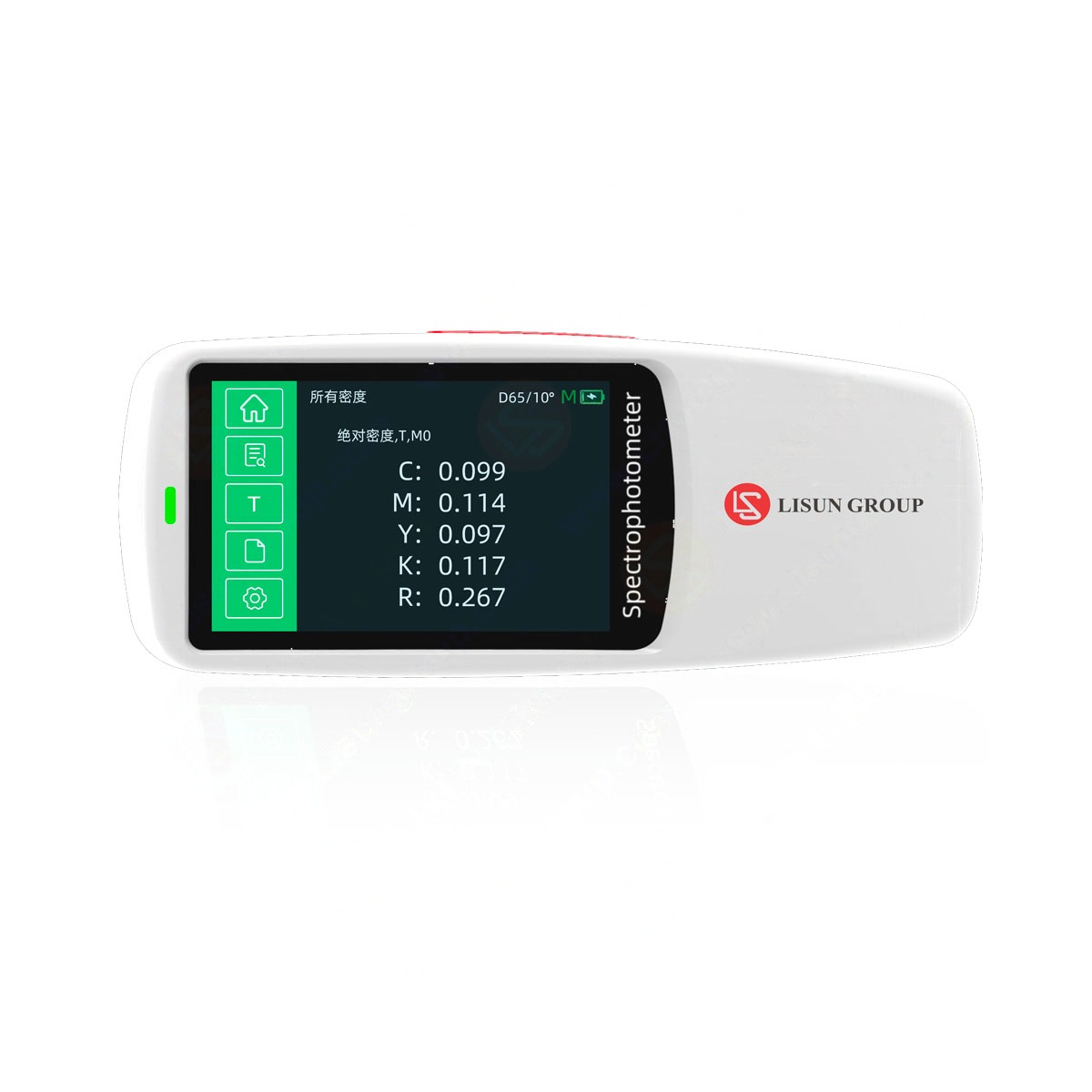
Overview
Print colour is controlled by density, tone value and trapping as much as by Lab values. LISUN's CD-626 range measures both: printing indicators such as colour density, tone value, trapping, contrast, hue error and grayness, alongside spectral reflectance and more than 30 colour parameters under nearly 40 illuminants. A physical positioning window lets the operator place the aperture accurately on a colour bar.
Repeatability is dE*ab≤0.02 across the range, using nano-spectroscopic optics and a dual 16-element silicon photodiode array over 400–700nm. The instruments connect over Bluetooth or USB to ColorExpert, LISUN's Windows colour management software, which holds shared colour libraries, compares samples against standards, exports reports and runs computer-aided colour matching for paint, coatings, printing and textiles.
Model differences
- CD-626: Φ5mm aperture.
- CD-628: Φ11mm, Φ5mm and Φ3mm apertures, plus UV light source.
- CD-630: Φ11mm, Φ10mm, Φ6mm, Φ5mm and Φ3mm apertures, UV light source and NetProf network calibration.
Key Specifications
| Specification | CD-626 | CD-628 | CD-630 |
|---|---|---|---|
| Measuring structure | 45/0 | ||
| Aperture | Φ5mm | Φ11mm, Φ5mm, Φ3mm | Φ11mm, Φ10mm, Φ6mm, Φ5mm, Φ3mm |
| UV light source | No | Yes | Yes |
| NetProf network calibration | No | No | Yes |
| Integrated physical positioning holes | Yes | ||
| Repeatability | dE*ab≤0.02 | ||
| Display accuracy | 0.01 | ||
| Light source | Full-band balanced LED; life 5 million measurements | ||
| Measurement indices | Spectral reflectance, CIE-Lab, LCh, Hunter Lab, Luv, XYZ, Yxy, RGB; colour difference ΔE*ab, ΔE*cmc, ΔE*94, ΔE*00; whiteness (ASTM E313-00, E313-73, CIE, ISO 2470/R457, AATCC, Hunter, Taube Berger Stensby); yellowness (ASTM D1925, E313-00, E313-73); blackness; stain and colour fastness; tint; CMYK density (A, T, E, M); metamerism index; Munsell; hiding power; dye and tinting strength | ||
| Illuminants | A, B, C, D50, D55, D65, D75, F1–F12, CWF, U30, U35, DLF, NBF, TL83, TL84, ID50, ID65 and LED illuminants (LED-B1 to B5, BH1, RGB1, V1, V2) | ||
| Field of view | 2°, 10° | ||
| Integrating sphere diameter (as published) | 40mm | ||
| Spectral method / sensor | Nano-spectroscopic device; dual 16-group silicon photodiode array | ||
| Wavelength range / interval | 400~700nm / 10nm | ||
| Reflectance range / resolution | 0~200% / 0.01% | ||
| Measurement time | About 1s | ||
| Interface | USB, Bluetooth | ||
| Screen | 3.5-inch full-colour | ||
| Battery | 7.2V / 3,000mAh, 8,000 measurements per charge | ||
| Storage | 10,000 results on the instrument; mass storage in the app | ||
| Software | Android, iOS, Windows (ColorExpert) | ||
LISUN lists a 45/0 measuring structure and a 40mm integrating sphere diameter in the same table. Confirm the measurement geometry with Finch if your standard specifies one.
Features
- Printing indicators: density, tone value, trapping, contrast, hue error, grayness
- dE*ab≤0.02 repeatability
- 30+ measurement parameters and nearly 40 illuminants
- Physical positioning window for accurate placement on colour bars
- ColorExpert PC software with colour libraries and colour matching
- UV light source on CD-628 and CD-630
Applications
- Offset, flexo and gravure print quality control
- Packaging and label printing
- Ink and coating colour matching
- Paper and board
Frequently asked questions
What does a densitometer measure that a colorimeter doesn't?
Printing-specific values: colour density (CMYK, status A, T, E, M), tone value, trapping, contrast, hue error and grayness. The CD-626 range reports these alongside standard Lab and colour difference values.
Which model should I choose?
The CD-626 has a single 5mm aperture. Choose the CD-628 or CD-630 if you need several apertures or a UV light source; the CD-630 also supports NetProf network calibration.