LMS-9500C — LISUN CCD Spectroradiometer
LISUN LMS-9500C Scientific Grade CCD Spectroradiometer — Hamamatsu TE-cooled detector, 350–800nm, wavelength accuracy ±0.2nm, traceable to NIM and NIST. Meets IES LM-79 and Energy Star.
Enquire About This Product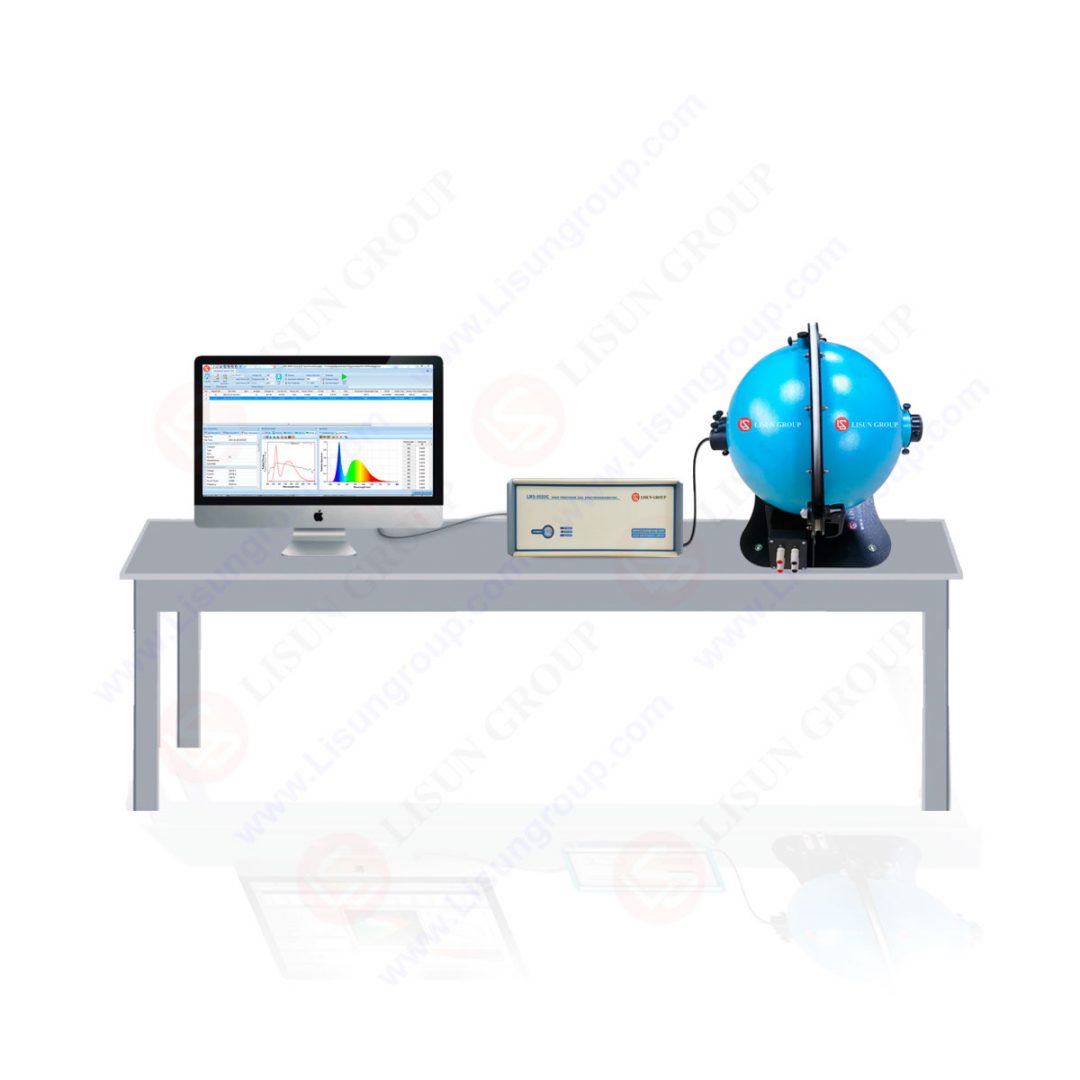
Overview
The LMS-9500C is LISUN's scientific-grade CCD spectroradiometer, meeting Energy Star IESNA LM-79 and GB/T24824 standards. It uses a Concave Average Diffraction Grating with a Hamamatsu TE-cooled (−10°C ±0.05°C) high sensitivity back-thinned CCD detector, combined with unique stray light control technology, wide dynamic linear technology, precision CCD electronic drive and complex matrix software. Results are traceable to China's NIM and the US NIST.
The LMS-9500C achieves spectral wavelength accuracy of ±0.2nm with resolution ±0.1nm. Chromaticity coordinate accuracy (Δx, Δy) is ±0.0015 under standard A lamp. CCT range is 1,500K–100,000K with accuracy ±0.2%. Integration time spans 0.1ms to 60s.
Four wavelength variants are available: LMS-9500C (350–800nm), LMS-9500CUV-VIS (200–800nm), LMS-9500CVIS-NIR (350–1050nm) and LMS-9500CSWIR (800–1700nm, InGaAs detector).
Key Specifications
Wavelength range: 350–800nm (C) / 200–800nm (UV-VIS) / 350–1050nm (VIS-NIR) / 800–1700nm (SWIR) | Wavelength accuracy: ±0.2nm | Resolution: ±0.1nm | Chromaticity accuracy (Δx,Δy): ±0.0015 (std A lamp) | CCT: 1,500K–100,000K; accuracy ±0.2% | CRI: 0–100, accuracy ±(0.3%rd±0.3) | Photometric linearity: ±0.2% | Stray light: <0.015% (600nm), <0.03% (435nm) | Integration time: 0.1ms–60s | Detector: Hamamatsu TE-cooled back-thinned CCD
Features
- Scientific-grade Hamamatsu TE-cooled back-thinned CCD detector (−10°C ±0.05°C)
- Concave average diffraction grating
- Unique stray light control technology
- Traceable to NIM (China) and NIST (USA)
- Wavelength accuracy ±0.2nm; resolution ±0.1nm
- Chromaticity accuracy ±0.0015 under standard A lamp
- Integration time 0.1ms to 60s
- Flux testing: spectrum, photometric, spectrum with photometric revision
- Four wavelength variants including SWIR (InGaAs) option
- Measures temperature inside and outside integrating sphere
Applications
CFL, HID, plasma light and tungsten halogen lamp testing; LED flux and colour testing with integrating sphere; Laboratory-grade photometric and colorimetric measurement; Goniophotometer system integration; Energy Star certification testing